
Does Colorado Wildfire Code Apply to Replacing Siding?
Colorado’s 25% siding rule can trigger whole-wall wildfire upgrades. Check local adoption, WUI status, project area, and qualifying assemblies.
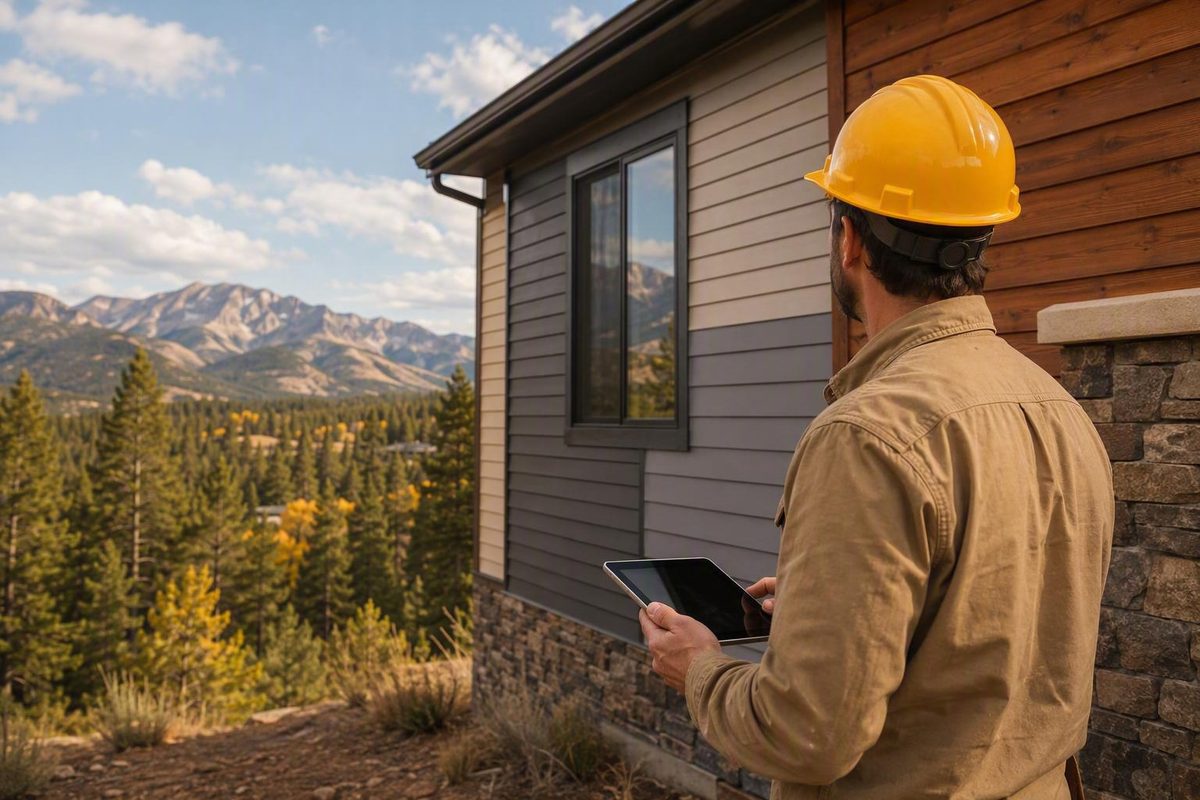
Yes—replacing siding can trigger Colorado’s Wildfire Resiliency Code when the governing jurisdiction has adopted the rules, the parcel is in the covered wildland-urban interface (WUI), and the work affects 25% or more of the building’s total exterior-wall area. Exactly 25% counts under the state model. Once triggered, the model generally requires the entire exterior-wall surface, including covered attachments, to meet new-construction requirements; existing walls already complying with Section 404.3 are excepted.
Select the jurisdiction, parcel, and project details to see the likely trigger and eligible material paths.
Colorado Siding Wildfire-Code Checker
This screens the state-model trigger. The local code official makes the parcel-specific decision.
Next step: ask the permitting authority to confirm the adopted code, parcel map, and accepted wall-area calculation in writing.
Exterior-Wall Material And Assembly Paths
A category is not approval. Submit the exact product, complete assembly, and installation documents required locally.
| Option | Possible Route | What Must Be Established | Installed Cost/Sq. Ft. |
|---|---|---|---|
| Metal siding | Noncombustible | Exact product documentation and approved installation | — |
| Fiber-cement siding | Noncombustible, if documented | Product classification, accessories, substrate, and installation | — |
| Fire-retardant-treated wood | FRT wood | Treatment and product documentation for the exact material | — |
| Tested ignition-resistant product | Ignition resistant | Accepted test or evaluation documentation and installation | — |
| Vinyl siding | Rated wall assembly | Underlying assembly must satisfy the jurisdiction’s criteria | — |
| Engineered wood or other cladding | Tested product or rated assembly | An accepted ignition-resistant or assembly-based path | — |
| Standard untreated wood | Not established | Supplied guidance does not show it as a stand-alone qualifying path | — |
| Existing Section 404.3-compliant wall | Existing-wall exception | Prior plans, permits, inspections, or accepted assembly evidence | — |
Sources: Colorado Wildfire Resiliency Code and Garfield County siding guidance. These sources provide no reliable statewide installed cost per square foot; unknown costs are marked —.
Painting, staining, and similar restorative work are exempt from this wildfire-code provision. Exterior-wall work affecting less than 25% is also exempt from this particular trigger, according to the official Colorado Wildfire Resiliency Code. That does not eliminate ordinary siding permits, building and fire codes, zoning rules, HOA restrictions, or stricter local WUI requirements.
The distinction between maintenance and replacement matters. Applying a new finish is different from removing and replacing exterior-wall material. Calling replacement a “repair” does not remove the need to calculate its affected area.
Three Gates Determine Whether Re-Siding Is Covered
The 25% rule matters only after jurisdiction and mapping have been resolved. Product choice comes later.
The Governing Jurisdiction Must Enforce The Rules
Start with the property address and parcel number. Depending on location, permitting and wildfire review may be handled by a city, county, regional building department, fire authority, or a combination of agencies.
Colorado established the 2025 model code through 8 CCR 1507-39. Qualifying governing bodies with code authority in WUI areas were required to adopt and enforce provisions meeting or exceeding the state minimum. The Colorado General Assembly’s SB23-166 summary explains that enforcement occurs under each governing body’s rules and regulations.
The local ordinance can differ from the model through amendments, map modifications, administrative rules, exceptions, effective dates, and stricter provisions. Ask the reviewing department:
- Which code edition and local amendments apply?
- Which application or permit date controls?
- Does a previously issued permit remain under an earlier code?
- Does changing the scope bring the project under the current code?
- Are older local WUI provisions still in force?
Obtain the ordinance and answer in writing. The state’s Wildfire Resiliency Code Board page provides the model code and statewide mapping resources, but the permit decision comes from the authority having jurisdiction.
The Parcel Must Be In The Applicable WUI Area
Search the actual parcel on the controlling WUI map. Record whether it is inside the WUI, its fire-intensity classification, the map version, and whether the jurisdiction uses the state map or an approved local modification.
Do not infer status from the neighborhood, county, vegetation, or mailing address. Similar nearby properties can fall into different mapped areas. Save a dated screenshot or PDF for the permit file.
The supplied code materials associate the more demanding exterior-wall treatment with Class 2 or Moderate/High conditions. They do not establish identical siding requirements for every classification. The local reviewer must confirm which classification and provisions govern the parcel.
Replacement Must Reach The Applicable Scope
For existing exterior walls, the state-model calculation is: affected exterior-wall area divided by total exterior-wall area, multiplied by 100.
The denominator is the building’s total exterior-wall surface area—not the damaged elevation, the street-facing wall, or the amount of siding ordered. Under the model, replacement affecting 25% or more triggers broader compliance. Work below 25% is exempt from this wildfire-code provision.
Additions and other significant exterior alterations can also require review. The supplied evidence does not establish one universal size rule for every addition, so the jurisdiction must classify that scope separately.
A homeowner cannot settle applicability merely by choosing fiber cement, metal, vinyl, wood, or another product. Coverage comes first; approval of the product and complete wall assembly comes second.
Exactly 25% Reaches The State-Model Threshold
Suppose a building has 2,000 square feet of total exterior-wall surface and the project replaces 500 square feet. The calculation is 500 divided by 2,000, multiplied by 100, which equals 25%.
That reaches the trigger because the model says “25 percent or more.” The project does not have to exceed 25%.
If the same building receives 240 square feet of replacement siding, the result is 12%. That is below the model threshold, although the jurisdiction can still require a siding permit or enforce another applicable rule.
Material orders are not reliable substitutes for wall measurements. Proposals commonly include waste, spare panels, cartons, or siding “squares” that do not correspond precisely to installed wall area. A reviewable calculation should show each elevation, its dimensions, the proposed replacement area, and the resulting whole-building percentage.
Ask the code official how to treat window and door openings, gables, dormers, garages, additions, mixed claddings, earlier repairs, and areas concealed by porches or decks. The available evidence does not establish one statewide measurement method for every configuration.
Do not assume that dividing one planned project into phases avoids the threshold. How related work is aggregated requires a local interpretation. Obtain a written determination when the design depends on remaining below 25%.
Local Wording Can Differ At The Boundary
Garfield County’s guidance says “more than 25%” for qualifying Medium/High Hazard properties, while the state model says “25 percent or more.” Those phrases differ at exactly 25%.
The county also states that siding replacement requires a building permit and that applicants must provide manufacturer information for the proposed siding. Its wildfire-code siding guidance is a useful local example, not a statewide permit rule.
For an exactly-25% project, ask which adopted text controls and have the department approve the measurement before materials are ordered.
Reaching 25% Can Expand The Entire Project
Once the state-model threshold is reached, the entire exterior-wall surface area generally must use materials required for new construction, including covered attachments. The stated exception is for existing walls already complying with Section 404.3.
The threshold also subjects the area within 5 feet of the structure to Section 503.1. The supplied evidence does not reproduce every requirement of that section, so a universal vegetation, paving, fencing, storage, or landscaping checklist would be unreliable.
Ask the reviewer to identify:
- Which exterior-wall surfaces must be upgraded
- Which attachments and adjoining components are included
- Whether any existing walls qualify for the Section 404.3 exception
- What work Section 503.1 requires within 5 feet
- When that site work must pass inspection
- Which plans, product records, and assembly details are required
“Entire exterior-wall surface” does not automatically mean every window, door, deck, soffit, eave, or trim component must be replaced. The official should define covered attachments and transitions for the particular building.
An estimate for one damaged elevation can therefore be incomplete even when its siding quantity is accurate. Separate the proposal into Original siding-replacement work, additional whole-exterior work, attachments, assembly upgrades, permit documentation, 5-foot-zone work, and concealed-condition allowances.
Compliant Siding Depends On The Approval Path
The model and Garfield County guidance identify four broad exterior-wall approaches for covered Class 2 or Moderate/High work:
- Noncombustible materials
- Ignition-resistant materials
- Fire-retardant-treated wood
- A qualifying fire-resistance-rated exterior-wall assembly
These are compliance paths, not blanket approval of every product in a material category. The exact cladding, substrate, sheathing, rated layers, joints, penetrations, fasteners, clearances, and installation can affect approval.
Metal and fiber cement may be submitted under a noncombustible-material path when the exact product documentation supports it. Fire-retardant-treated wood requires documentation for the treated product. Engineered wood or another product would need to qualify under an accepted ignition-resistant or assembly-based path rather than relying on its category name.
Standard untreated wood is not established as a qualifying option by the supplied guidance. A manufacturer’s use of phrases such as “fire safe,” “wildfire ready,” or “Class A” is not itself a permit approval; those descriptions can refer to different tests or components.
Vinyl Requires An Acceptable Underlying Assembly
Vinyl is not universally banned in Colorado, but it is not automatically compliant. Garfield County’s guidance allows it only when the underlying wall assembly satisfies specified fire-resistance criteria.
That makes concealed layers important. The department may request wall-section drawings, sheathing and underlayment details, test reports, evaluation reports, installation instructions, and fastener or penetration details. Acceptance at one property does not establish approval in another jurisdiction.
Once the department identifies acceptable options, compare their Installed cost, expected service life, Maintenance, appearance, Repairability, moisture behavior, and impact performance. The cited code sources do not provide reliable statewide installed costs per square foot, so cost entries in the checker are shown as unknown rather than estimated.
Existing Compliant Walls Need Evidence
The Section 404.3 exception can reduce the required scope when part of the building already uses an accepted wall. The visible siding alone does not prove compliance.
Useful evidence can include approved plans, earlier permits, inspection records, product and assembly documentation, construction photographs, test reports, and installation details. Ask what the jurisdiction will accept when records for concealed layers are unavailable.
Local Rules Can Produce Different Answers
Reporting on an Archuleta County presentation described the code as applying in mapped WUI areas to new construction and significant exterior alterations or additions, while excluding routine maintenance and painting. It also described Class 2 exterior-wall requirements and local discretion over implementation in the Pagosa Springs Sun’s account.
That does not classify every deteriorated-siding project as maintenance. Removing and replacing material still requires an area calculation and local review.
Lyons illustrates a separate distinction. After Colorado fires destroyed 324 homes, as covered by Denver7, the town considered an ordinance directed at existing houses. The proposal included clearance beneath combustible siding but did not require siding replacement and was not final when reported by 9NEWS.
A construction-triggered code applies when an owner undertakes covered work. A retrofit ordinance can impose duties without a siding project. The reported Lyons proposal should not be treated as enacted statewide law.
Get The Scope Approved Before Ordering Siding
Give every bidder the same parcel classification, measurements, and written direction from the department. The permit file should contain:
- The parcel address and number
- The governing building and fire authorities
- The adopted code, ordinance, and amendments
- The controlling WUI map and fire-intensity classification
- Elevation measurements and the affected-area calculation
- Photographs of all exterior walls
- The exact manufacturer, product, profile, thickness, and finish
- Installation instructions and requested test or evaluation reports
- Existing and proposed wall-section details
- The department’s decision on attachments and the 5-foot zone
- Approved plans, inspections, substitutions, and final records
Ask whether any siding replacement requires a permit even when the wildfire calculation is below 25%. Sheathing repair, electrical fixtures, gas vents, flashing, weather barriers, historic review, zoning, or design changes can create separate requirements.
For work near the threshold, do not sign a fixed-scope contract or place a nonreturnable order until the department accepts the measurement. If 25% or more is reached, the contract should distinguish the original siding work from whole-exterior compliance, assembly documentation, attachments, site work, inspections, and concealed conditions.
A written local determination is the reliable answer for a specific home. The state model supplies the 25% rule, but the parcel map, adopted ordinance, accepted measurement, and approved wall assembly determine what must actually be built.