
When to Replace Siding: Condition, Extent, Moisture
When failure is confined to one side but spot repairs would be impractical, replacing one elevation can be the right middle option.
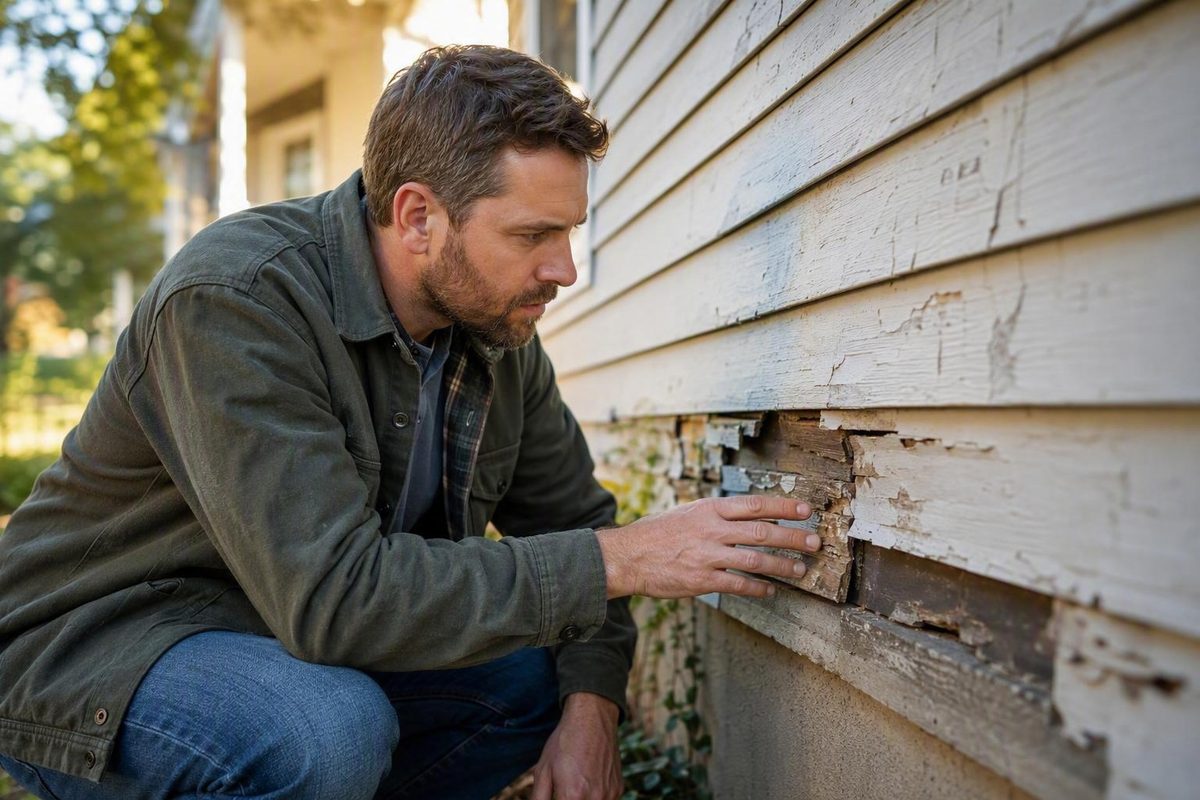
Knowing when to replace siding is less about finding one dramatic warning sign and more about answering three questions: What condition is the siding in, how extensive is the problem, and has moisture reached the wall behind it?
Age and appearance provide context, but neither proves that siding has failed. One cracked panel over dry, firm sheathing may need only a targeted repair. Similar cracking across several walls, recurring leaks, soft sheathing, or repeated installation defects may justify replacing one elevation or the entire exterior.
The Short Answer: Use Condition, Extent, and Moisture to Decide
Start with this four-level symptom-to-action matrix:
| What you observe | Likely action | What determines the final scope |
|---|---|---|
| Uniform fading, dated color, superficial staining, light finish wear, or an isolated dent that has not opened the siding | Monitor or address cosmetically | Confirm that there are no cracks, open seams, loose sections, softness, leaks, or coating failure that exposes the material |
| One cracked panel, a small impact hole, a few loose pieces, or limited early rot | Arrange a targeted repair | Adjacent siding must be stable, the cause must be understood, and the substrate must remain dry and sound |
| Bubbling, recurring leaks, soft or spongy areas, indoor water stains, open seams, extensive decay, or widespread warping | Investigate promptly | Determine whether water has reached the water-resistive barrier, sheathing, insulation, or framing |
| Similar failures across a wall or multiple elevations, repeated repairs, moisture damage in several places, or systemic installation defects | Consider partial or complete replacement | Base the scope on documented damage, substrate condition, repairability, and whether the original defect can be corrected |
Ordinary fading or an outdated color is primarily cosmetic when the siding remains intact and there are no performance symptoms. You may still choose replacement for style or curb appeal, but that is a discretionary renovation—not proof that the exterior has failed.
Likewise, an isolated defect does not automatically justify re-siding the house. A single damaged vinyl panel, puncture from yard equipment, loose board, or small area of early wood decay may be repairable when the surrounding cladding and underlying wall remain sound. Commercial contractor guidance generally distinguishes limited defects from widespread or recurring problems, although an inspection may be needed to determine what lies behind the surface (Energy Home Improvements’ repair-versus-replacement overview).
Moisture-related symptoms deserve more urgency, but they are not an automatic diagnosis. Bubbling, soft material, recurring leaks, extensive rot, interior staining, and widespread deformation indicate that the wall assembly needs investigation. They do not establish by sight whether the correct solution is a small repair, replacement of one wall, or a complete tear-off.
Replacement becomes more plausible when:
- The same failure returns after repair.
- Similar defects appear across many components or elevations.
- Water has entered in multiple locations.
- Flashing or the water-resistive barrier is defective in repeated locations.
- Sheathing or framing is soft, decayed, swollen, or otherwise damaged.
- Compatible repairs cannot be made reliably.
- The remaining siding is too brittle, distorted, or unstable to support durable spot repairs.
There is no universal percentage of damaged siding at which every house must be re-sided. Extent matters, but depth and recurrence often matter more. Several isolated impact marks over sound sheathing may be less consequential than one recurring leak that has damaged the wall around a window.
Age works the same way: it is context, not a deadline. Older siding deserves closer examination, but its current condition, repairability, and ability to manage water should drive the decision.
Exterior Warning Signs—and How Urgent Each One Is
A long list of “replacement signs” can make every blemish sound equally serious. It is more useful to sort exterior symptoms by urgency.
Monitor during routine maintenance
These conditions generally permit observation unless they are changing or accompanied by other damage:
- Uniform fading: Color loss alone does not mean the siding has stopped functioning.
- Superficial staining: Dirt, runoff marks, or surface discoloration may call for appropriate cleaning and investigation of the runoff source.
- Finish wear: A weathered coating may need maintenance rather than replacement if the underlying material remains sound.
- Isolated dents: A dent that has not split, punctured, opened a seam, or loosened a component may be cosmetic.
Photograph these areas and compare them over time. Dated images can help establish whether a crack is expanding, a seam is opening, or a board is continuing to deform.
Arrange a repair soon
One or a few cracked, punctured, loose, or missing components should be assessed before they become entry paths for rain or pests. Check the surrounding material at the same time.
Repair is most plausible when:
- Damage is confined to a small, identifiable area.
- Adjacent panels or boards remain secure.
- There is no recurring leak or related indoor symptom.
- The sheathing is dry and firm where it can be assessed.
- The cause—such as an impact or isolated fastener failure—is understood.
- A compatible replacement component is available.
Cracks, holes, missing sections, and gaps can expose deeper layers, but they do not reveal how far damage has spread. A visible opening may have remained dry under a protected overhang, while a less conspicuous flashing defect may have admitted water repeatedly.
Inspect promptly
Do not postpone investigation when you find:
- Soft or spongy siding
- Visible rot or extensive decay
- Large open seams
- Repeated panel detachment
- Widespread buckling, bulging, or warping
- Bubbling or blistering
- Biological growth that returns or appears connected to persistent dampness
- Rust or corrosion affecting numerous metal sections
- Water staining beneath windows or roof-to-wall intersections
Bubbles or blisters can indicate trapped moisture, but the source could involve the siding, flashing, drainage plane, roof runoff, or another exterior detail. Manufacturer guidance similarly describes blistering and interior dampness as possible building-envelope symptoms rather than purely cosmetic defects (CertainTeed’s overview of exterior and interior warning signs).
Recurrence is particularly important. If a panel keeps coming loose, a seam repeatedly opens, or staining returns after repairs, the original work may not have corrected the cause.
Inspect the whole exterior, not only the obvious spot
Review every accessible elevation from roofline to foundation. For areas that cannot be observed adequately from the ground, arrange an appropriate professional inspection rather than treating an incomplete view as confirmation that the area is sound.
Give extra attention to:
- Window and door perimeters
- Roof-to-wall intersections
- Utility, vent, hose, and cable penetrations
- Outside and inside corners
- Chimneys and attached structures
- Lower siding edges
- Deck and porch connections
- Areas below gutters and downspouts
- Walls shaded by dense landscaping
- Locations exposed to sprinkler spray or repeated splashback
Do not remove siding or perform destructive probing unless the person doing the work can assess and correctly restore the affected weather-management layers. Visible symptoms should direct the investigation, not substitute for it.
Interior Symptoms That May Point to Hidden Moisture
Exterior wall problems sometimes appear indoors first. Possible corroborating symptoms include:
- Unexplained dampness near an exterior wall
- Brown, yellow, or dark staining
- Peeling or blistered interior paint
- Bubbling wallpaper
- Soft, swollen, or warped drywall
- Persistent musty areas
- Mold that returns after cleaning
- Damp trim or flooring near windows and doors
These symptoms can occur when moisture passes through a compromised exterior wall assembly. None proves that siding is the source.
An investigation should also consider:
- Roof leaks
- Window or door flashing
- Roof-to-wall flashing
- Plumbing supply or drain leaks
- Indoor condensation
- Exhaust vents and exterior penetrations
- Gutter overflow or concentrated roof runoff
Active leaks, soft drywall, and recurring moisture deserve prompt attention because the condition of concealed sheathing and framing cannot be inferred from the exterior surface. Peeling finishes and warped drywall are recognized as possible signs of water entering an exterior wall, but commercial home-services guidance also makes clear that the cause requires investigation (Constellation Home’s discussion of siding and moisture symptoms).
Cleaning visible growth, repainting a stain, or replacing the panel nearest the symptom may improve appearances without closing the water-entry path. If defective window flashing is directing water behind the siding, for example, installing a new panel alone leaves the causal defect in place.
Drafts and rising utility bills are weaker clues. Siding gaps may contribute to air leakage, but windows, doors, attic insulation, penetrations, ducts, air sealing, weather, household use, and HVAC performance may be more important. Investigate those factors before treating energy use as evidence that the siding requires replacement.
How Age and Siding Material Change the Decision
Service-life estimates are planning ranges, not mandatory replacement schedules. Published figures conflict because “vinyl siding” or “wood siding” describes a broad category rather than one product installed under one set of conditions.
Commercial home-services guidance commonly publishes approximate ranges of:
- Vinyl: 20–40 years
- Wood: 20–40 years
- Engineered wood: 20–30 years
- Fiber cement: 30–50 years or longer
- Aluminum: roughly 20–50 years across different sources
One contractor-published guide lists 20–40 years for vinyl and wood, 20–30 years for engineered wood, and 30–50 years for fiber cement and aluminum (published material lifespan ranges). Another commercial source lists aluminum at 20–40 years and fiber cement at 50 years or more, illustrating why these numbers should not be treated as expiration dates.
These estimates are not guarantees. Actual performance varies with product grade, installation quality, climate, sun exposure, moisture, maintenance, pests, impacts, wall design, and drainage details. New siding can fail early if flashing, housewrap, fastening, or clearances were mishandled. Older siding can remain serviceable when it is stable, maintained, and still directing water outward.
Material also affects repairability:
- Vinyl: An individual interlocking panel can often be replaced. The main complication may be finding a compatible profile and a color that does not contrast sharply with weathered siding.
- Wood: Individual boards or shingles can often be replaced when decay is limited and the substrate remains dry. The moisture source and protective finish still need attention.
- Fiber cement: Localized chips, impact damage, or limited cracking may be repairable. Deep damage or significant cracking across numerous boards can make elevation replacement more practical.
- Metal: An isolated dent or damaged section may be addressed locally, but extensive corrosion, widespread finish failure, or deformation across many pieces can favor broader replacement.
A material entering an estimated age range is not the same as that material losing function. Age should prompt closer inspection, a review of maintenance history, and realistic planning—not an automatic tear-off.
Homeowners comparing replacement materials can consult the comparison guide listed by Siding Spot, which covers vinyl, fiber cement, wood, metal, and engineered wood by cost, lifespan, maintenance, and common failure mode. Those comparisons should still be checked against the exact product’s current installation and warranty documents.
Repair, Replace One Elevation, or Re-Side the Whole House?
Avoid jumping directly from one damaged component to whole-house replacement. Work through these six factors in order.
1. How extensive is the damage?
Localized damage affects a limited number of components in one contained area. Adjacent siding remains stable, and no substrate damage has been identified.
Widespread damage means similar failures appear across a wall, on multiple elevations, or among numerous components. It should not be defined by an arbitrary universal percentage.
If one panel was cracked by a mower-thrown stone, begin with a localized repair assessment. If panels are splitting or warping across three sides of the house, a broader evaluation is warranted.
2. Has the problem recurred?
Recurring damage is a condition that returns after repair or a series of failures linked to the same unresolved cause.
Ask:
- Has this area been repaired before?
- Does staining return after wind-driven rain?
- Do panels repeatedly detach in the same location?
- Are cracks developing around the same windows?
- Did previous repairs address the flashing or drainage detail, or only the visible siding?
Recurrence shifts the decision away from repeated patching and toward correcting the underlying system.
3. Is there evidence of moisture?
A dry, firm substrate supports a narrower repair. Repeated leaks, soft sheathing, swollen materials, or moisture symptoms in several locations support broader investigation.
Moisture does not automatically require whole-house replacement. If damage is confined to one poorly flashed window, that assembly and the surrounding section may be repairable. If the same flashing or housewrap defect is present throughout the original installation, a wider scope becomes more defensible.
4. What is the substrate condition?
The relevant substrate includes the materials behind the visible siding, particularly the water-resistive barrier and sheathing. An assessor may need to distinguish among:
- Sound, dry substrate
- Surface staining without confirmed deterioration
- Suspected concealed damage
- Confirmed softness, swelling, decay, or loss of integrity
- Visible framing damage requiring a separate repair scope
This distinction is central. New cladding installed over unresolved wet or damaged material does not correct the underlying wall problem.
5. Can the siding be repaired reliably?
A repair should restore function, not merely hide the symptom. Consider whether damaged components can be removed without destabilizing adjacent material, whether flashing can be integrated correctly, and whether the remaining siding is sound enough to reinstall.
Targeted repair is generally the logical first option when the damage is contained, the substrate is dry and firm, the cause is understood, and compatible material is available.
6. Is matching material available?
Even a technically straightforward repair may be visually conspicuous. Existing siding may have faded, and the original profile, texture, or exposure may have been discontinued.
That creates three potential scopes:
- Targeted repair: Best for contained defects when an acceptable compatible component is available.
- One-wall or one-elevation replacement: A legitimate middle option when failure is confined or panel-by-panel work would look fragmented or be impractical.
- Whole-house replacement: Most plausible when failure is widespread or recurring, damage is present behind multiple areas, installation defects are systemic, or the remaining siding cannot support reliable repairs.
Partial replacement can introduce visible transitions, difficult stopping points, color differences, and product-compatibility questions. Material-specific contractor guidance notes that individual wood components are often repairable, while extensive fiber-cement cracking or difficult vinyl matching may make elevation replacement more practical (Pacific Exteriors’ material-by-material repair discussion).
Before approving phased or partial work, check the exact manufacturer’s installation instructions and warranty terms. Do not assume that requirements applying to one product or installation system apply to another.
Finally, keep functional need separate from preference. Replacing sound siding for a new color, style, resale plan, or curb appeal can be reasonable, but it is a remodeling choice rather than proof of failure.
What a Thorough Siding Inspection Should Cover
Visible cladding is only one part of the exterior wall. A useful recommendation should explain how the affected area is intended to manage water and why the observed failure may have occurred.
The following is a homeowner discussion checklist, not a universal technical inspection standard. The applicable details depend on the siding product, wall system, building configuration, local requirements, and what can be assessed safely.
Ask the inspector or contractor to address:
- Siding condition on every elevation
- Cracks, deformation, corrosion, decay, and finish failure
- Seams, laps, joints, and fastening
- Corner boards, trim, and transitions between materials
- Utility and mechanical penetrations
- Window and door flashing
- Roof-to-wall and chimney flashing
- Clearances from roofs, decks, soil, paving, and landscaping, checked against the exact product instructions
- Drainage paths and locations where water appears trapped or concentrated
- The water-resistive barrier or housewrap where it is already visible or exposed through agreed limited removal
- Sheathing and visible framing where they can be assessed
- Soffits, fascia, and vents
- Pest entry or visible damage
- Gutter overflow, roof runoff, sprinkler exposure, splashback, and dense vegetation
Commercial inspection guidance similarly recommends looking beyond the cladding to sheathing, moisture, flashing, housewrap, pests, soffits, fascia, and ventilation-related details (Summit Construction Group’s repair-versus-replacement guidance).
For each defect, ask for the likely cause—not merely a description of the symptom. “Warped siding” records what is visible. “Warping associated with over-fastening,” if supported by the inspection, identifies a condition that may need correction during repair.
Useful project documentation can include:
- Overview and close-up photographs
- Locations identified by elevation
- A description of any moisture observations or measurements
- A distinction between directly observed damage and suspected concealed damage
- A record of any areas opened through agreed limited removal
- Repairs considered necessary for function
- Optional appearance or efficiency upgrades listed separately
- Assumptions and exclusions
Where feasible, request separate scopes for targeted repair, one-elevation replacement, and complete replacement. That makes the tradeoffs visible and helps prevent optional upgrades from being presented as mandatory work.
Consider another opinion when moisture remains unexplained, the proposed scope is extensive, or the findings do not appear to support the recommendation. Informal tapping, casual probing, and an isolated homeowner moisture reading should not be treated as conclusive evidence of concealed rot or framing damage.
Cost, Maintenance, and Matching: When Continued Repairs Stop Making Sense
There is no dependable national price promise for a particular house. Contractor-published figures vary by region, material, project size, access, and assumptions about hidden conditions. One commercial guide, for example, publishes a broad whole-house replacement estimate of $8,000–$30,000, but it also identifies exterior area, material, building height, architectural complexity, and underlying wall condition as major price variables.
A project quote may be affected by:
- Measured exterior area rather than interior floor area
- Siding material, grade, profile, and finish
- Number of stories
- Access requirements
- Architectural complexity
- Gables, dormers, bump-outs, and attached structures
- Trim and accessory details
- Removal and disposal
- Permits or local requirements where applicable
- Local labor conditions
- Flashing correction
- Housewrap or water-resistive barrier work
- Sheathing or framing repairs
Ask the contractor to separate the base siding price from allowances for concealed damage. The proposal should explain what is included, what is excluded, and how additional work will be documented and priced if removal exposes deterioration.
Use this worksheet before comparing scopes:
| Decision factor | Your notes |
|---|---|
| Known or estimated siding age | |
| Material and profile | |
| Number of past repairs | |
| Location and date of each repair | |
| Problems that have returned | |
| Current annual maintenance | |
| Known moisture history | |
| Availability of matching material | |
| Expected years of ownership | |
| Repair, elevation, and whole-house bid totals | |
| Exclusions and concealed-damage allowances |
Repeated repairs can support replacement when they reveal a systemic failure. Several repair invoices, however, do not automatically prove that full replacement is cheaper. Compare what was repaired, whether the work corrected the cause, and whether similar failures are continuing elsewhere.
Matching can also change the practical choice. A technically adequate new panel may contrast with sun-weathered siding, or the original profile may no longer be available. That can make one-elevation replacement visually preferable without making whole-house replacement structurally necessary.
Phased replacement by elevation may help spread costs when each phase has a sensible stopping point. Before using that strategy, confirm how the phases will preserve flashing, drainage, seams, trim integration, material compatibility, and the exact product’s warranty conditions.
Treat promised energy savings cautiously. Removing siding may create an opportunity to improve air sealing, insulation, flashing, or housewrap. Siding alone, however, is not the primary determinant of household energy use. Any efficiency proposal should identify the specific improvement rather than attributing savings generically to “new siding.”
Finally, compare itemized bids built around the same scope. A lower headline total may exclude removal, trim, flashing, disposal, or substrate repairs included in another proposal.
A Homeowner Action Plan Before Approving Replacement
Before signing a contract, take the following steps.
-
Document every elevation. Take dated overview photographs and close-ups of cracks, loose sections, stains, warping, gaps, and storm damage. Photograph related interior symptoms as well.
-
Build a timeline. Record when each symptom first appeared, whether it follows rain or seasonal weather, and whether it has changed.
-
List previous repairs. Note what was repaired, who performed the work, and whether the same symptom returned.
-
Address active water entry promptly. Do not wait for a complete remodeling decision before arranging appropriate help to control an active leak and protect the interior.
-
Ask the assessor to map the damage. The recommendation should show what is isolated, widespread, recurring, directly observed, or suspected to be concealed—and how those findings affect the proposed scope.
-
Check alternative causes. Ask whether roofing, window or door flashing, roof-to-wall details, plumbing, condensation, gutters, penetrations, and air leakage have been considered.
-
Confirm that the work addresses the cause. Replacing panels without correcting defective flashing, fastening, clearance, or drainage may reproduce the failure.
-
Review the exact product requirements. Obtain the proposed manufacturer, product line, profile, installation instructions, maintenance duties, and warranty terms. Do not rely on generic promises for a material category.
-
Handle storm claims carefully. Preserve dated photographs, invoices, and temporary-repair records. Review the policy and the insurer’s written position before assuming that repair, matching, one-elevation replacement, or whole-house replacement will be covered. Commercial contractor guidance also cautions that coverage depends on policy terms, documentation, and the scope of damage (storm-damage and repair guidance).
-
Seek another opinion when the evidence and scope do not align. A recommendation for complete replacement based mainly on age or appearance should be supported by findings about moisture, substrate condition, damage distribution, installation defects, and repair feasibility.
The practical decision rule is simple: repair contained damage over a sound substrate; investigate moisture and recurring failure promptly; consider broader replacement when the failure, underlying damage, or original installation defect is systemic.
Should siding be replaced just because it has reached a certain age?
No. Age is a planning signal, not an expiration date. Consider the material, installation history, maintenance, exposure, present condition, moisture performance, and repair history. Older siding may remain functional, while relatively new siding can fail because of poor flashing, fastening, housewrap, or drainage.
Can I replace only one wall or elevation of siding?
Yes. One-elevation replacement can be an appropriate middle option when failure is confined to one side but individual repairs would be impractical. Before proceeding, resolve how new and existing materials will meet, whether colors and profiles are compatible, and whether the layout, flashing, drainage, installation instructions, and warranty terms permit the phased scope.
Do fading, mold, or higher energy bills mean I need new siding?
Not by themselves. Fading is often cosmetic. Exterior biological growth may be superficial or may point to a moisture source that needs investigation. Higher energy bills can result from windows, insulation, air leakage, ducts, HVAC performance, weather, or household use. Look for corroborating evidence before attributing any of these symptoms to siding failure.
How can I tell whether water has damaged the sheathing behind my siding?
You generally cannot confirm the condition of concealed sheathing by looking at the siding alone. Soft areas, recurring leaks, interior stains, swelling, or deformation raise concern, but appropriate assessment or limited removal may be needed. Ask the inspector to document what was directly observed, what was measured, and what remains suspected.
What should I ask before accepting a full siding-replacement recommendation?
Ask for:
- The location and extent of every documented failure
- Any moisture findings and how they were obtained
- The observed condition of the sheathing and visible framing
- The likely cause of each defect
- Evidence that the issue is widespread, recurring, or systemic
- An explanation of why targeted repair would not be durable
- A separate one-elevation option where practical
- Details for correcting flashing, housewrap, fastening, and drainage defects
- An itemized price with exclusions and rules for additional work
- Product-specific installation and warranty information
The final scope should follow the evidence found on the house—not age alone, cosmetic concerns, energy claims, or a sales presentation.