
Vinyl vs. Hardie Siding: Cost Now, Upkeep Later
Commercial guides cite about 10-15 years as a planning interval for field-painted fiber cement. Conventional vinyl costs less upfront and avoids routine painting.
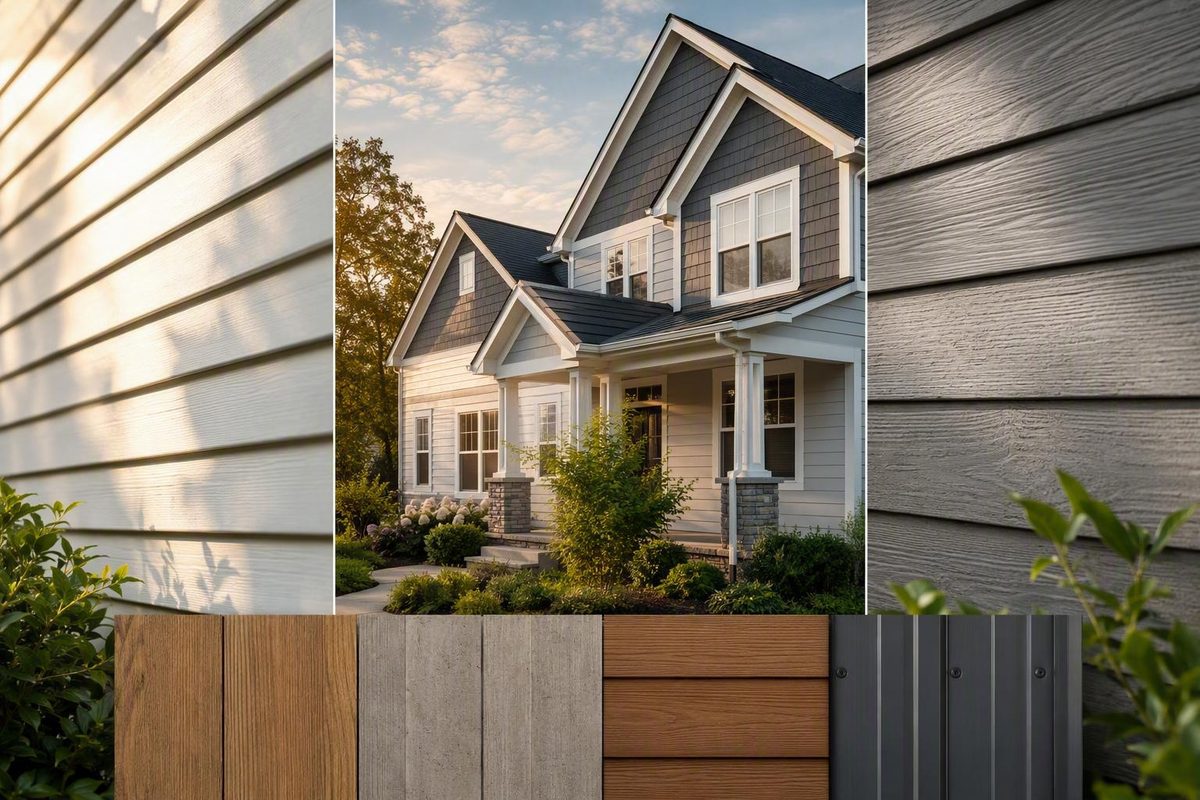
The short answer: where vinyl wins and where Hardie wins
In a vinyl vs. Hardie siding comparison, vinyl generally wins on upfront affordability, light weight, installation speed, and freedom from routine repainting. James Hardie fiber cement generally wins on rigidity, lower thermal movement, repaintability, and the ability to create deeper, more substantial-looking details.
For fire-sensitive projects, some fiber-cement products may also be candidates when their current technical documents establish the required noncombustibility or assembly performance. That is not a category-wide guarantee: the siding, trim, substrate, fasteners, and wall assembly must be verified individually.
There is no universal winner. The practical choice depends on five questions:
- What can you comfortably spend now?
- How long do you expect to own the home?
- What heat, cold, moisture, wildfire, hail, wind, and sun exposures affect it?
- What appearance suits the home and neighborhood?
- Are you willing to inspect and eventually repaint a finished fiber-cement exterior?
Quality vinyl is often the rational choice for constrained budgets, rental properties, starter homes, shorter ownership periods, and homeowners who want to avoid routine painting. Premium vinyl may offer a more rigid panel than an entry-level product, while insulated vinyl combines the cladding with attached foam. Those upgrades do not make all vinyl systems equivalent, so compare exact product lines rather than the category name.
Hardie may justify its premium for a long-term owner who wants a more substantial exterior, future color flexibility, or lower thermal movement. It may also suit premium homes and renovations where deeper shadow lines or a traditional painted appearance matter. If documented fire performance is a priority, the proposal must identify the exact product and applicable technical documentation rather than relying on the word “Hardie.”
That advantage comes with heavier installation, more demanding handling and detailing, and eventual finish work. Primed, field-painted, and factory-finished Hardie products also have different maintenance implications.
The label alone does not determine the result. Both product selection and water-management details affect performance—not merely whether the proposal says “vinyl” or “fiber cement” (Energy Home Improvements’ comparison of installation and project scope).
Before choosing, examine the complete installed cost, exact product, climate-specific risks, installer qualifications, wall condition, finish system, and quote inclusions. The sections below provide a cost framework, climate matrix, ownership worksheet, installation checklist, and bid-comparison scorecard.
What vinyl and Hardie siding actually are
Conventional vinyl siding is PVC-based exterior cladding. It is formed into lightweight panels with profiles, textures, colors, and locking or overlapping edges appropriate to the selected system.
James Hardie is a brand of fiber-cement siding, not the name of the entire material category. Hardie products use cement-based ingredients and cellulose fibers, but Hardie-specific testing, warranties, installation instructions, and performance claims cannot automatically be assigned to another fiber-cement manufacturer. A commercial material overview describes conventional vinyl as PVC resin and Hardie siding as a cement-, sand-, water-, and cellulose-fiber product (Alsco’s material comparison).
The choice is also broader than two uniform products. A homeowner may be comparing at least five systems:
- Entry-level conventional vinyl
- Thicker premium vinyl
- Foam-backed or insulated vinyl
- Factory-finished Hardie
- Primed Hardie that will be field-painted
These differences affect price, rigidity, color options, impact behavior, repairability, finish work, and possible warranty terms. A basic vinyl panel should not be judged as though it were premium insulated vinyl. Likewise, factory-applied and field-applied fiber-cement finishes should not be assigned the same maintenance assumptions.
Polymer composite cladding is another category. For example, Alside Ascend uses a reinforced polymer and foam construction rather than the same configuration as ordinary hollow-backed PVC siding. Findings about that product—including cost, insulation, fire, and durability claims—cannot be generalized to every vinyl panel.
The fundamental physical differences explain many of the later tradeoffs:
- Vinyl is light and temperature-responsive. Panels are installed so they can expand and contract rather than being clamped rigidly to the wall.
- Fiber cement is heavy and rigid. It generally undergoes less thermal movement, but boards require more labor to carry, cut, fasten, detail, and replace.
- Vinyl color is normally integral to the selected product system. Repairs often involve inserting another panel.
- Fiber cement relies on a protective finish. Damage may require edge treatment, touch-up, board replacement, or repainting of a larger section.
Neither category is immune to damage. Vinyl can be punctured, cracked, displaced, or deformed under some exposures. Fiber cement can chip, crack, stain, or develop finish problems. Exact outcomes depend on product grade, substrate, fastening, exposure, installation, and maintenance.
Installed cost: why Hardie usually costs more
Published contractor estimates consistently place conventional vinyl below James Hardie in upfront installed cost. The figures vary too much by location, date, product, access, and scope to support one authoritative national price.
One contractor comparison reports $4–$9 per square foot for vinyl and $8–$14 for Hardie. The page does not establish an audited national dataset, so these figures should be treated as commercial planning estimates rather than market benchmarks (Home Genius Exteriors’ cost comparison).
A Chester County, Pennsylvania, contractor published 2026 estimates of $5–$9 per square foot for vinyl and $12–$18 for James Hardie. That local example illustrates how labor markets, product selection, access, and project scope can produce a much larger gap than another published range (Mighty Dog Roofing’s Chester County comparison).
These are examples, not promises. A current quote measured for your house is more useful than an online range.
Why fiber cement generally carries more labor cost
Fiber cement adds work at several stages:
- Boards are heavier to unload, stage, lift, and position.
- Cutting requires suitable tools and worker dust controls.
- Rigid boards are less forgiving around irregular walls and complicated trim.
- Fastening, joint treatment, edge repair, flashing, and clearances must follow the selected product’s current instructions.
- Upper stories may require more labor or access equipment.
- Replacing a damaged board is generally more involved than unlocking and replacing an accessible vinyl panel.
- Field-painted systems add surface preparation and painting.
Vinyl is lighter and usually faster to handle, but it is not detail-free. Panels need correct fastening, overlap, accessory installation, movement allowance, drainage, and product-specific wind detailing.
Wall area is not floor area
A “2,000-square-foot house” does not necessarily have 2,000 square feet of siding.
A meaningful proposal should be based on measured exterior wall area and should account for:
- Windows and doors
- Gables
- Dormers
- Bump-outs and projections
- Multiple stories
- Waste and cutting
- Mixed materials such as masonry
- Difficult access
- Complex trim and architectural details
Ask the contractor to state the measured siding area and explain how openings and waste were treated. Otherwise, two prices “per square foot” may use different denominators.
Scope can outweigh the material-price difference
Each proposal should identify whether it includes:
- Removal of existing siding
- Disposal and dump charges
- Inspection and repair of sheathing
- Weather-resistant barrier or drainage-plane work
- Window, door, penetration, and roof-to-wall flashing
- Starter strips, corners, mounts, and accessories
- Window, door, band, frieze, and corner trim
- Soffit and fascia
- Scaffolding, lifts, or other access equipment
- Permits and inspections
- Caulking and painting
- Protection of landscaping
- Daily and final cleanup
- Taxes and contingency allowances
Do not compare a material-only or minimally scoped price with a complete proposal that includes tear-off, wall repair, flashing, trim, painting, permits, and cleanup.
Hardie also does not inevitably “pay for itself.” A valid break-even calculation requires local installation prices, financing costs, repainting, repairs, possible replacement, planned sale date, and assumptions about how long each installation will remain serviceable.
For a short ownership period, the added initial cost may never benefit the current owner financially. Over a longer period, durability and repaintability may become more valuable, but repainting and labor still belong in the calculation.
Lifespan, durability, and how each siding can fail
Commercial contractor estimates commonly cluster around 20–40 years for vinyl and 30–50 years for Hardie. These are conditional planning ranges, not independently validated or guaranteed service lives. One contractor guide uses those ranges while acknowledging that product grade, climate, installation, and maintenance affect the result (Forever Exteriors’ lifespan comparison).
Conversely, thin vinyl on a highly exposed wall may show damage before carefully detailed fiber cement. Headline lifespan numbers cannot account for every wall orientation, storm, drainage defect, repair, or maintenance history.
How vinyl can fail
Possible vinyl failure modes include:
- Punctures and cracks: Hail, tools, ladders, landscaping equipment, or flying debris can damage panels.
- Cold-weather brittleness: Some products may become less tolerant of impact at low temperatures.
- Buckling or rippling: Panels fastened too tightly or deprived of movement space can distort as temperatures change.
- Wind detachment: Panels or accessories may unlock or pull away if the product, substrate, fastening, or installation does not suit the exposure.
- Fading or chalking: UV exposure and aging can change appearance, with results varying by color and product.
- Heat deformation: Concentrated reflected sunlight, grills, and other intense heat sources can deform some vinyl products.
These are possible failure modes, not inevitable outcomes. Product formulation, color, thickness, wall exposure, installation, and heat-source placement all matter.
How fiber cement can fail
Possible Hardie or fiber-cement failure modes include:
- Chipped edges or faces: Handling, cutting, impact, or improper storage can damage boards.
- Cracked boards: Impact, fastening errors, structural movement, or unsuitable detailing can create cracks.
- Visible touch-ups: Poorly blended touch-up coatings may differ from a factory finish in color or sheen.
- Staining or finish deterioration: Persistent wetting, drainage problems, damaged coatings, or deficient clearances can affect appearance.
- Failed caulk or flashing details: Open transitions and poorly managed joints can admit water behind the cladding.
- Loose boards: Inadequate fastening, substrate problems, or installation errors can allow movement or detachment.
Fiber cement is not impact-proof, moisture-proof, or maintenance-free. Its rigidity and cement-based composition provide useful characteristics, but they do not eliminate the need for correct wall design and finish care.
Repairing damage
An individual vinyl panel can be relatively straightforward to replace when it remains accessible and the installer knows how to unlock the surrounding courses. The harder problem may be finding the same profile and color years later. Even a nominally matching new panel can stand out beside weathered siding.
Replacing a fiber-cement board generally involves more weight, cutting, fastening, and finish work. Because the surface is paintable, however, a contractor may sometimes blend a repair by repainting the board, wall, or architectural section. Factory-finished repairs require particular attention to the approved repair method and visual consistency.
Before buying either system, ask:
- Does the distributor routinely stock this product line?
- Is the profile likely to remain available?
- Can unopened spare panels or boards be left with the homeowner?
- What is the minimum service charge for a future repair?
- Who can match the factory or field-applied finish?
- Can trim and accessories be replaced independently?
Keep product labels, color names, lot information, invoices, and suitable offcuts. That documentation can make a later repair less speculative.
Maintenance and ownership cost over time
Vinyl normally requires periodic inspection and gentle cleaning rather than routine painting. Cleaning frequency depends on shade, dirt, pollen, mildew conditions, landscaping, and wall exposure. Damaged or displaced panels still require repair, and an aged or discontinued color may be difficult to match.
Hardie maintenance depends on the finish system. Do not treat factory-finished, primed, and field-painted siding as though they were identical.
A painted fiber-cement exterior may require:
- Gentle cleaning
- Inspection for chips and exposed edges
- Review of caulked transitions
- Correction of persistent wetting or staining
- Local finish touch-ups
- Eventual repainting
Commercial guides often cite approximately 10–15 years as a planning interval for repainting field-painted fiber cement, but this is not a universal schedule. Finish quality, preparation, climate, color, wall orientation, access, and current product guidance all affect timing. A 2025 contractor guide distinguishes factory-finished products from primed material and uses a 10–15-year estimate for field-painted Hardie (Smithrock Roofing’s maintenance comparison).
Factory-applied finishes may delay near-term finish work, but “factory-finished” does not mean the siding can never require touch-ups or repainting. Obtain the current maintenance instructions and finish warranty for the exact product before modeling future costs.
Build an ownership-cost worksheet
Create a separate worksheet for each exact product and finish system. Do not compare entry-level vinyl with factory-finished Hardie, or insulated vinyl with bare fiber cement, without recording those differences.
| Cost field | Vinyl | Hardie |
|---|---|---|
| Manufacturer and product line | ___ | ___ |
| Product tier or thickness | ___ | ___ |
| Finish system | ___ | ___ |
| Wall-system upgrades included | ___ | ___ |
| Initial complete project price | $___ | $___ |
| Financing or borrowing cost | $___ | $___ |
| Cleaning through planned sale date | $___ | $___ |
| Localized repairs | $___ | $___ |
| Caulk or finish work | $___ | $___ |
| Repainting | Usually $0 unless an approved coating project is planned | $___ |
| Possible partial or full replacement | $___ | $___ |
| Planned sale year | ___ | ___ |
| Source and date of each cost input | ___ | ___ |
| Total estimated ownership cost | $___ | $___ |
Run the worksheet at four horizons:
Include likely repairs and near-term finish work, but do not automatically assume either system needs replacement.
20 years: Add plausible repainting for the selected fiber-cement finish if current product guidance and local painting estimates support it. Consider significant vinyl repairs as a scenario rather than a certainty.
30 years: Test more than one outcome. One scenario may include continued vinyl service; another may include partial or complete replacement. For Hardie, model repainting only at intervals supported by the selected finish and local conditions.
40 years: Include major-intervention scenarios for both materials. If you are performing a formal present-value analysis, account for when each future expense occurs and include financing where relevant.
Use low, expected, and high estimates instead of one precise total. Long-term comparisons are highly sensitive to assumptions about repainting, replacement, storm damage, inflation, and how long you remain in the home.
Before selecting fiber cement, obtain at least one local exterior-painting estimate based on the home’s height, trim complexity, preparation needs, and access. Repainting a simple one-story house is not the same project as repainting a tall, highly detailed exterior.
Fire, heat, cold, moisture, hail, and wind
Climate recommendations should be based on the exact product and wall assembly—not broad statements such as “vinyl is best in wet regions” or “Hardie is best in every harsh climate.”
Fire terminology matters
A Class A surface-burning classification is not automatically the same as noncombustibility. The terms can refer to different tests and characteristics. Noncombustible cladding also does not make a wall assembly or house fireproof.
The evidence available here does not establish one current fire classification for every Hardie siding product, trim component, or wall assembly. For wildfire, code, or insurance decisions, require the bidder to provide current documentation identifying:
- The exact siding and trim products
- The applicable test or evaluation
- The tested substrate and wall configuration
- Fastener and spacing requirements
- Joint, vent, opening, and penetration details
- Any limits on the claimed performance
Vinyl, as plastic cladding, can soften or deform under sufficiently high or concentrated heat. James Hardie’s own marketing discussion specifically warns that grill heat or concentrated reflected sunlight can disfigure some vinyl, but it does not prove that every vinyl product behaves identically (James Hardie’s siding-material overview).
Climate and hazard decision matrix
| Exposure | Vinyl considerations | Hardie or fiber-cement considerations | What to verify |
|---|---|---|---|
| Wildfire or nearby flame | Do not infer code compliance from the category name; plastic cladding can be affected by high heat | Some exact products may have relevant documentation, but the cladding alone does not make the wall fireproof | Current product and assembly reports, local code, wildfire rules, vents and openings |
| Concentrated heat | Reflected window heat, grills, and other sources may deform some products | Heat deformation may be less of a design concern, but coatings and adjacent components still require review | Product limits, grill placement, reflected-light conditions |
| Severe cold | Product-specific impact behavior and movement details matter | Rigid boards depend on sound fastening and protection from persistent wetting | Product suitability, substrate, fastening, repair plan |
| Freeze-thaw cycling | Panels must remain free to expand and contract | Finish integrity, flashing, drainage, and required clearances remain important | Current installation instructions and drainage details |
| Persistent rain or humidity | Low water absorption does not eliminate water behind the cladding | Cement-based composition does not eliminate finish or moisture-management needs | Weather-resistant barrier, flashing, penetrations, drainage path |
| Hail | Panels may puncture or crack | Boards may chip or crack | Product-specific impact documentation, substrate, exposure, repairability |
| High wind | Panels or accessories can unlock or detach | Boards can loosen or crack if the fastening or substrate is deficient | Tested assembly, design pressure, fastening schedule, local code |
| High UV | Color and surface appearance may change over time | Finish longevity varies by coating, color, and orientation | Product-specific finish information and comparable local installations |
These are screening considerations, not engineering conclusions. Contractor comparisons identify potential puncture, cracking, detachment, chipping, and heat-related failure modes, but actual resistance depends on the exact product and installation (Energy Home Improvements’ hazard overview).
Wet walls still need drainage
Vinyl does not absorb water like many porous materials, but wind-driven rain can pass through joints and openings. Fiber cement’s composition and protective finish also do not create a waterproof wall. Both systems need a drainage plane or weather-resistant barrier, integrated flashing, managed penetrations, and a route for water to leave the assembly.
The practical question is not simply “Which siding resists water?” It is: What happens to water that gets behind it?
Inspect roof-to-wall intersections, deck attachments, window and door heads, hose bibs, light fixtures, vents, utility penetrations, and lower-wall splash zones. If those details are wrong, changing the face material may not solve the underlying problem.
Hail and wind require product-specific evidence
Vinyl can puncture, crack, or detach. Fiber cement can chip, crack, or loosen. Neither statement establishes how a particular product will perform on your house.
Ask for documentation identifying:
- Exact product and profile
- Substrate requirements
- Fastener type and spacing
- Wind design or tested assembly
- Impact test, if an impact claim is made
- Required accessories
- Exposure limitations
- Repair procedure after damage
Verify local building codes, wildfire regulations, HOA restrictions, and insurer requirements directly. A weighted siding scorecard cannot override a legal requirement, an insurer’s condition, or a site-specific design requirement.
Appearance, color flexibility, and energy performance
Appearance is subjective. Fiber cement’s thickness and rigidity can create deeper shadow lines and more substantial detailing, which some homeowners prefer on traditional, historic-looking, or premium exteriors.
Vinyl can still look appropriate and polished when the profile, exposure, corners, trim proportions, seams, and color suit the architecture. A carefully designed vinyl installation may look better than fiber cement with awkward trim or poorly planned joints.
Color and future changes
With vinyl, color is generally selected as part of the product system. That reduces routine painting but makes future color changes less straightforward.
Do not assume vinyl can never be painted. Some manufacturers may permit compatible coatings under specified conditions. Before considering it, check the exact manufacturer’s current instructions, permitted colors, coating compatibility, preparation requirements, and effect on warranty coverage.
Painted fiber cement offers more direct future color flexibility. That can be an advantage for a long-term owner who expects to refresh or change the exterior. The tradeoff is that paint becomes a maintenance item.
Repairs also affect appearance:
- New vinyl may not match older weathered panels.
- A replacement profile may become unavailable.
- Fiber-cement touch-ups can be conspicuous if sheen or application differs.
- Repainting a larger board group or wall may be needed for a consistent result.
Siding is not an insulation strategy by itself
Standard vinyl and standard fiber-cement cladding contribute little insulation compared with the complete wall assembly. One contractor comparison reports that neither standard material reaches an R-value of 1 by itself, although the exact thermal result depends on the product and assembly (Home Genius Exteriors’ insulation discussion).
Insulated vinyl should be treated as a separate option. A fair efficiency comparison would be:
- Insulated vinyl over the proposed wall assembly, versus
- Fiber cement over exterior continuous insulation and the proposed wall assembly
Comparing insulated vinyl with bare fiber cement conflates cladding choice with insulation choice.
Siding cannot replace air sealing, cavity insulation, exterior continuous insulation, attic work, or proper window and penetration detailing. It should not be expected to guarantee a specific reduction in energy bills.
Do not assume either option guarantees a resale premium. Consider instead whether the material, profile, trim, and finish fit the home’s architecture and local buyer expectations.
Installation quality and the wall behind the siding
Siding is cladding, not a waterproof wall. Water can get behind both vinyl and fiber cement through laps, joints, penetrations, wind-driven rain paths, and transitions. The concealed wall system must manage that water without allowing it to remain against vulnerable materials.
Shared essentials
Both systems require attention to:
- Sound, adequately prepared sheathing
- A continuous weather-resistant barrier or drainage plane
- Properly integrated window and door flashing
- Kick-out flashing where a roof terminates against a wall
- Managed utility and mechanical penetrations
- A clear drainage route
- Correctly detailed decks, ledgers, and attachments
- Roof runoff and splashback
- Compatible trim and accessories
Soft sheathing, recurring stains, mold odors, or damaged flashing should be investigated before new siding covers the wall.
Vinyl installation priorities
A vinyl proposal should address:
- Room for temperature-driven expansion and contraction
- Correct nail placement without pinning panels tightly
- Appropriate panel overlap
- Secure corner, starter, utility, and opening accessories
- Product-specific wind details
- Straight, stable substrate preparation
- Drainage and flashing behind the panels
Fastening vinyl as though it were rigid board siding can contribute to buckling and distortion. Leaving panels inadequately engaged or failing to secure accessories can contribute to wind problems.
Hardie installation priorities
A Hardie proposal should address:
- Dry, supported storage and careful handling
- Approved cutting methods and tools
- Current worker controls for cutting dust
- Product-specific fasteners and fastening patterns
- Required clearances from roofs, paving, soil, and other surfaces
- Flashing and joint treatment
- Treatment of field-cut edges
- Approved finish-repair methods
- Compatibility with the substrate and weather barrier
- Compliance with current instructions for the exact product and region
Cutting fiber-cement material can create respirable silica dust, an occupational hazard for installers. A regional contractor installation guide discusses the cutting exposure and distinguishes it from ordinary exposure to installed siding, but the contractor should follow current manufacturer and occupational-safety requirements rather than relying on an older article (Blue Jay Exterior Renovations’ installation review).
Do not copy clearance or fastening dimensions from an old article or a different region. Current product documentation and local code govern the selected installation.
Why documentation matters
Installation defects can cause visible distortion, loose boards, staining, water intrusion, and shortened service life. They may also lead to disputes over responsibility. Any claim about current warranty coverage, exclusions, transferability, registration, or proof of installation should be checked against the warranty for the exact product being purchased.
Ask about experience with the exact product line—not merely “siding experience.” A crew that primarily installs vinyl may not have equal familiarity with factory-finished fiber cement, and the reverse may also be true.
Retain an installation file containing:
- Product labels and invoices
- Product line, profile, color, and lot information
- Photos before tear-off
- Photos of exposed sheathing
- Written records of substrate repairs
- Weather-barrier and drainage-plane photos
- Window, door, penetration, and roof-to-wall flashing photos
- Fastening and accessory details
- Photos before concealed work is covered
- Permits and inspection reports
- Paint and caulk specifications
- Current warranty and maintenance materials
- Registration confirmation, if applicable
- Final completion photos
This record can help with future repairs, claims, warranty questions, and sales disclosures.
How to choose and compare contractor quotes
Use your priorities to narrow the product category, then compare equivalent systems rather than vague labels.
Scenario-based recommendations
Choose quality conventional vinyl when:
- Lower upfront cost is the dominant constraint.
- You want to avoid routine exterior painting.
- Your ownership period may be short or uncertain.
- Local contractors have strong experience with the exact product.
- The profile and trim suit the house.
Consider premium vinyl when:
- You want a more substantial panel than an entry-level product.
- Better accessories, finish options, or verified product-specific performance justify the upgrade.
- You still want vinyl’s low-painting maintenance model.
Consider insulated vinyl when:
- You want a cladding system with attached continuous insulation.
- The proposal compares it fairly with other exterior-insulation options.
- Energy improvements are evaluated as part of the complete wall rather than attributed to siding alone.
Consider Hardie when:
- The exact proposed product has the fire documentation your project requires.
- Lower thermal movement matters for the design.
- You want a paintable exterior and accept future finish work.
- Deeper detailing suits the architecture.
- A longer ownership horizon makes the initial premium easier to justify.
- A qualified installer is available for the exact system.
Postpone the material decision when:
- Sheathing is soft.
- Interior or exterior staining suggests leakage.
- Moldy odors are present.
- Roof-to-wall drainage is defective.
- Windows or penetrations lack credible flashing.
- The cause of repeated siding damage is unknown.
Correcting the wall and water-management problem comes before selecting a new cladding face.
Require exact product identification
Every quote should name:
- Manufacturer
- Product line
- Profile and exposure
- Thickness or grade where applicable
- Color and finish system
- Factory-finished or field-painted status
- Trim system
- Corners, starter components, mounts, and accessories
- Insulation or backer, if included
- Exact wind, impact, or fire assembly being claimed
- Fastener and substrate requirements
“Premium vinyl” and “Hardie siding” are not sufficiently specific descriptions for a contract.
Require equivalent itemization
Ask each bidder to price or explicitly exclude:
- Tear-off
- Disposal
- Sheathing repairs
- Weather-resistant barrier
- Drainage or rainscreen components
- Window and door flashing
- Kick-out and roof-to-wall flashing
- Penetration detailing
- Trim
- Soffit and fascia
- Access equipment
- Permits
- Painting and preparation
- Caulking
- Cleanup and landscape protection
- Taxes
- Hidden-damage contingency prices
Also establish who will:
- Identify concealed damage
- Photograph and document repairs
- Approve change orders
- Coordinate inspections
- Provide technical documentation
- Complete any required registrations
- Retain product records
- Handle future labor claims
- Return for punch-list or warranty work
Compare warranty substance, not the headline
Using the current documents for the exact products, review:
- Substrate coverage
- Finish coverage
- Labor exclusions
- Fading or color provisions
- Impact and storm exclusions
- Moisture and installation exclusions
- Transferability
- Prorating
- Maintenance duties
- Registration requirements
- Required proof of compliant installation
Obtain at least two bids with equivalent scope. Normalize exclusions before comparing totals by adding realistic allowances for work included by one contractor but omitted by another.
If you also want to compare fiber cement and vinyl with wood, metal, or engineered wood, Siding Spot has a broader guide to types of house siding, costs, lifespans, maintenance, and failure modes.
Final decision scorecard
Assign each category a weight totaling 100. Score every option from 1 to 5, then multiply the score by the weight.
Use the same scoring direction for every category:
- 1: Poor fit or unacceptable uncertainty
- 2: Significant compromise
- 3: Adequate, with manageable tradeoffs
- 4: Strong fit
- 5: Excellent fit supported by the quote and product documentation
| Decision input | Suggested weight | Vinyl score | Hardie score |
|---|---|---|---|
| Available upfront budget | ___ | ___ | ___ |
| Planned ownership period | ___ | ___ | ___ |
| Fire and weather exposure | ___ | ___ | ___ |
| Desired appearance | ___ | ___ | ___ |
| Maintenance tolerance | ___ | ___ | ___ |
| Access to a qualified installer | ___ | ___ | ___ |
| Total | 100 | ___ | ___ |
For fire and weather exposure, award a high score only when the exact product, tested assembly, and proposed installation address the identified hazard. Do not award points based solely on a category-wide marketing claim.
Treat totals separated by less than about 10% as effectively close rather than as a decisive mathematical result. In that situation, compare the quality of the installers, wall-repair scope, finish system, and uncertainty in your assumptions.
Some conditions override the scorecard entirely:
- Applicable code or wildfire requirements
- HOA restrictions
- Insurer conditions
- Unresolved leakage or damaged sheathing
- An installer unable to document the proposed system
- A bid that omits necessary flashing or drainage work
The scorecard organizes judgment; it does not replace technical documentation or repair an incomplete proposal.
Frequently asked questions
Is Hardie siding worth the extra cost over vinyl?
It can be, but not for every homeowner. Hardie is easier to justify when you expect to own the home for a long time and place high value on rigidity, lower thermal movement, repaintability, substantial detailing, or exact product documentation relevant to a fire-sensitive project.
Vinyl is often the better financial fit when upfront affordability and avoiding routine repainting are the main priorities. Do not assume Hardie will automatically recover its premium through resale or lower lifetime costs. Compare local installation prices, finish work, repairs, financing, possible replacement, and your planned sale date.
How long do vinyl and Hardie siding typically last?
Contractor estimates commonly place vinyl around 20–40 years and Hardie around 30–50 years, but these are conditional planning ranges rather than guaranteed service lives (Forever Exteriors’ contractor estimates).
Product grade, sunlight, concentrated heat, freeze-thaw exposure, storms, installation, drainage, maintenance, and repair history can shorten or extend actual service. The warranty period is not the same as expected service life.
Does Hardie siding need to be repainted?
It may. Primed or field-painted Hardie should be expected to need finish inspection, localized repairs, and eventual repainting. Commercial estimates often use approximately 10–15 years as a planning range, but actual timing varies with preparation, coating, climate, color, sunlight, wall orientation, and maintenance (Smithrock Roofing’s field-painted Hardie estimate).
Factory-finished Hardie should be evaluated separately. A factory finish may postpone repainting, but it does not mean the siding will never need touch-up or refinishing. Follow the current instructions for the exact product.
Which siding is better for fire, hail, and extreme temperatures?
There is no safe category-wide answer.
For fire, ask whether the exact siding product and proposed wall assembly have current documentation applicable to your code, wildfire, or insurance question. Do not treat a Class A surface-burning classification as automatically equivalent to noncombustibility, and do not treat noncombustible cladding as a fireproof house.
For hail, vinyl may puncture or crack, while fiber cement may chip or crack. Under concentrated heat, some vinyl may deform. In severe cold, product-specific impact behavior and correct movement allowances deserve attention. Fiber cement still depends on correct fastening, finish integrity, flashing, drainage, and clearances.
The better choice is the documented product and assembly suited to the local exposure—not the category with the strongest marketing phrase.
Does insulated vinyl make a home more energy efficient than Hardie?
Insulated vinyl can add continuous insulation compared with an otherwise similar wall using standard hollow-backed vinyl or bare fiber cement. The fair comparison, however, is insulated vinyl versus Hardie installed over an appropriate continuous-insulation system.
Actual energy performance depends on the entire wall, including air sealing, cavity insulation, exterior insulation, thermal bridges, windows, penetrations, and installation quality. Neither siding option substitutes for missing insulation or air-sealing work, and neither should be expected to guarantee a specific reduction in energy bills.
The bottom line: Vinyl is usually the rational option when price, faster installation, and avoiding repainting dominate. Hardie may be worth the premium when lower thermal movement, repaintable color, substantial detailing, a long ownership horizon, or product-specific fire documentation matter enough to justify higher installation and finish-maintenance costs.
Make the final decision using exact product lines, measured wall area, local hazards, equivalent bid scopes, current technical and warranty documents, and evidence that the selected installer will correctly detail the entire drainage and flashing system.