
Price to Replace Vinyl Siding: Scope, Area and Repairs
For preliminary budgeting, expect about $5–$12 per square foot installed, with one crucial caveat: "installed" does not always mean complete replacement.
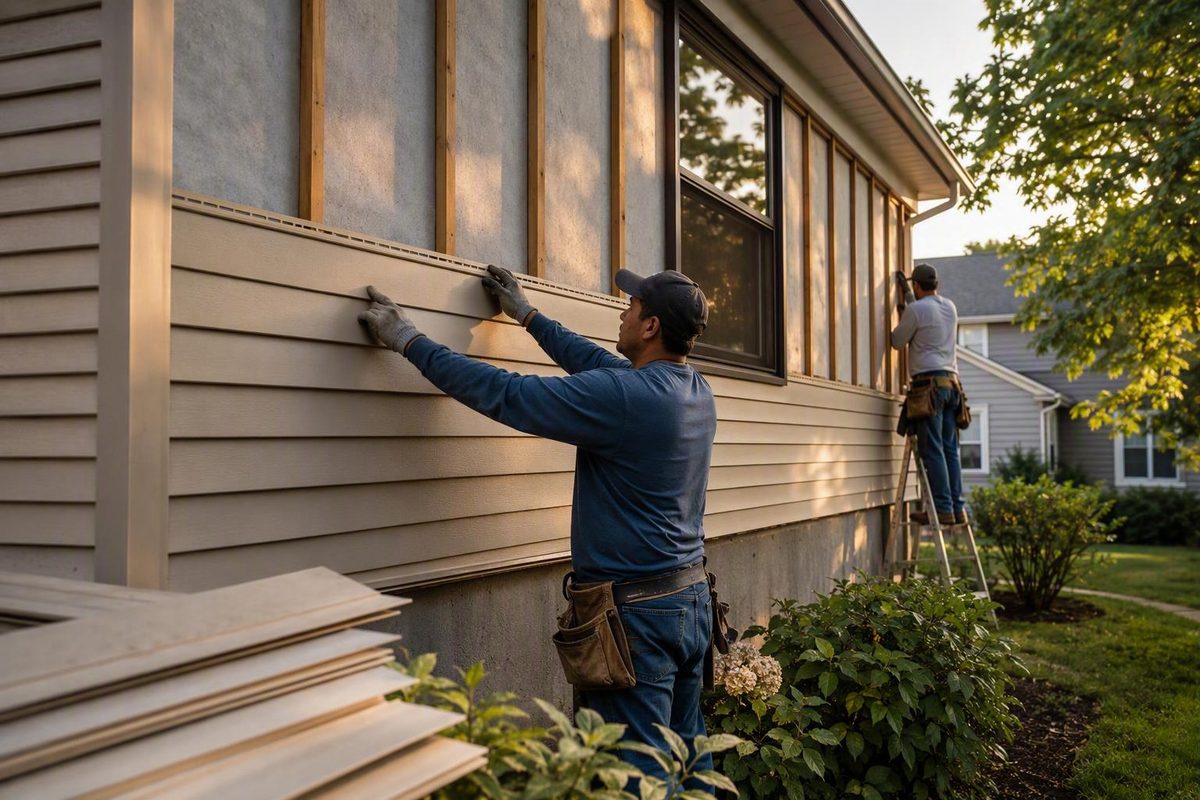
The short answer: a realistic 2026 vinyl siding replacement budget
For preliminary budgeting, a practical price to replace vinyl siding is about $5–$12 per square foot installed, with the important qualification that “installed” does not always mean complete replacement. One contractor-authored guide uses that range for removal, surface preparation, and new installation, while noting that repairs, permits, and disposal can still increase the total. See the contractor’s stated $5–$12 replacement range.
Some broader estimates reach approximately $14 per square foot, depending on product, labor, and the expenses included in “replacement.” A contractor guide comparing repair and replacement, for example, gives vinyl replacement a range of $5–$14 per square foot but does not establish that every possible replacement expense is included. Review the broader $5–$14 replacement estimate.
Applying the $5–$12 planning rate to 1,500 square feet of measured exterior siding area produces an arithmetic subtotal of $7,500–$18,000. That calculation uses the published installed rate above; it is not automatically an all-in contract price. Confirm whether the rate covers tear-off, hauling, disposal, weather barrier, flashing, trim, permits, taxes, access equipment, and repairs discovered after removal.
Published whole-project figures are not directly interchangeable. NerdWallet, citing Angi, reports a typical total of $6,369–$18,274 and an average of $12,221, while also emphasizing differences in grade, design, labor, removal, and underlying repairs. Review NerdWallet’s published cost figures and qualifications. A separate 2026 publisher example places a basic 1,500-square-foot ranch at approximately $12,500–$15,000, but that is an illustrative budget rather than a documented customer invoice.
Projects can also move beyond $20,000. A regional contractor serving Michigan and Ohio reports that many of its own replacement projects cost $22,000–$32,000, with scope generally including standard panels, trim, house wrap, labor, single-layer removal, preparation, cleanup, disposal, and permits where required. That is company- and region-specific pricing, not a national average. Compare the contractor’s stated pricing and scope.
Homewyse demonstrates why scope matters. Its May 2026 basic vinyl siding installation estimate is $7.32–$12.51 per square foot, but the displayed installation total excludes removal and debris-disposal charges listed separately on the page. Its base estimate covers siding, basic labor, common supplies, equipment, setup, and cleanup under favorable conditions—not every expense involved in replacing existing siding. Review Homewyse’s May 2026 estimate.
| Estimate type | Planning range | Pricing date | Measurement basis | Major inclusions or exclusions |
|---|---|---|---|---|
| Contractor-authored installed replacement estimate | $5–$12 per sq. ft. | Publication date not disclosed | Described using a 1,500-sq.-ft. example; readers should verify that the figure means exterior wall area | Removal, surface preparation, and installation stated as included; repairs, permits, and disposal may add cost |
| Contractor-authored repair-versus-replacement guide | $5–$14 per sq. ft. | Date and methodology not disclosed | Per square foot; precise area convention not disclosed | Complete scope is not fully specified |
| Homewyse basic installation | $7.32–$12.51 per sq. ft. | May 2026 | Finished surface area plus enclosed openings under Homewyse’s input method | Siding, basic labor, supplies, equipment, setup, and cleanup; displayed total excludes separately listed removal and debris charges |
| Illustrative 1,500-sq.-ft. calculation | $7,500–$18,000 | Derived from the published $5–$12 rate | 1,500 sq. ft. of exterior siding area | Arithmetic subtotal only; exclusions must be confirmed |
| This Old House illustrative ranch budget | About $12,500–$15,000 | Updated June 2026 | Described as a 1,500-sq.-ft. ranch; exterior wall quantity is not independently established | Includes stated allowances of about $1,000 for trim and accessories and $1,000 for removal and disposal |
| Regional contractor project range | $22,000–$32,000 | Current quote required | Exterior wall coverage | Broad stated replacement scope, but limited to one contractor’s regional business model |
These figures synthesize commercial calculators, editorial guides, and contractor-published estimates. They do not constitute a statistically representative database of national bids. Dates, geography, product grade, measurement conventions, and included work differ, so national figures are budgeting tools—not substitutes for itemized local quotes.
Installation price versus complete replacement price
A price per square foot becomes useful only after you identify its scope. Three categories should not be blended.
Material-only pricing covers siding panels and perhaps selected accessories. It does not establish what a contractor will charge to prepare the walls, install the panels, detail openings, provide access equipment, or clean the site. A material-only shelf price is therefore not comparable with an installed contractor price.
Basic installed pricing typically combines panels with routine installation labor. Depending on the estimator, it may also include fasteners, flashing components, sealants, ordinary equipment, delivery, setup, and cleanup. These estimates often assume accessible walls, common products, and favorable conditions. Tear-off and disposal may remain outside the headline rate.
Complete replacement pricing may include:
- Removal of existing siding and trim
- Loading, hauling, and disposal
- Inspection and routine preparation of exposed walls
- House wrap or another weather barrier
- Flashing at openings, transitions, and penetrations
- New siding, starter strips, channels, corners, and accessories
- Window, door, eave, and transition trim
- Permits and inspections where required
- Lifts, scaffolding, and site protection
- Final cleanup
- Defined allowances or unit prices for concealed repairs
Homewyse’s displayed basic-installation total is a clear example of a limited scope. It includes siding, labor, supplies, equipment, setup, and cleanup, while removal and debris disposal appear as separate line items. Sales tax, permits, hazardous-material work, and unspecified structural or system repairs are also excluded.
The regional contractor example takes a broader approach. Its stated standard scope generally includes panels, trim, house wrap, labor, single-layer removal, wall preparation, cleanup, haul-away, and permits where required. Multiple layers, sheathing or structural repairs, custom trim, soffit, fascia, gutters, and premium colors can still add cost.
Do not automatically add labor to an installed rate. Do not automatically add tear-off, overhead, supervision, or profit either. First determine whether each cost is already embedded. Adding it twice can turn a reasonable estimate into an inflated budget.
Before comparing two per-square-foot prices, normalize them with this checklist:
- Area: Are both contractors pricing the same exterior wall and gable area?
- Openings: Are windows and doors included in or subtracted from billable area?
- Waste: What overage is included in the purchased quantity?
- Product: Are the manufacturer, product line, profile, color, and construction equivalent?
- Labor: Is installation labor included?
- Removal: Does tear-off cover every existing layer?
- Disposal: Are containers, hauling, dump charges, and cleanup included?
- Preparation: What wall preparation is included before work becomes a repair?
- Weather protection: Are wrap, flashing, tapes, and sealants included?
- Trim: Which corners, channels, starter pieces, window details, and custom bends are covered?
- Permits and taxes: Are they included, allowed for, or excluded?
- Repairs: Are concealed repairs controlled by unit prices or open-ended change orders?
Only after those assumptions match does a comparison such as “$9 versus $11 per square foot” become meaningful.
Measure siding area—not the home’s floor area
Siding quantity is driven by exterior wall coverage, not interior living area. Two houses with 2,000 square feet of floor space can require substantially different siding quantities. A broad one-story house may have a long perimeter, while a compact two-story design has taller walls. Gables, dormers, attached garages, additions, and bump-outs further change the surface area.
A basic field measurement follows this sequence:
- Sketch each elevation. Draw the front, rear, and both sides separately. Divide irregular elevations into rectangles and triangles.
- Measure rectangular walls. Multiply each wall’s width by its siding height.
- Measure triangular gables. Multiply the base by the height and divide by two.
- Measure other covered surfaces. Treat dormers, additions, and bump-outs separately.
- Record openings. Measure windows and doors even if a contractor’s pricing method does not subtract them.
- Total the wall and gable surfaces.
- Add the specified material allowance.
- Measure soffit, trim, and accessories separately.
Vinyl siding is sold in 100-square-foot units called squares. Lowe’s measurement method calculates rectangular walls as width multiplied by height, triangular areas as one-half of base multiplied by height, and adds 10% for trimming waste and minor measurement error. It also treats soffit, trim, and accessories as separate quantities. Use Lowe’s siding measurement guide.
For a house with 1,500 square feet of net wall and gable area, a 10% material allowance produces:
- Net siding area: 1,500 square feet
- 10% allowance: 150 square feet
- Planning purchase quantity: 1,650 square feet
- Equivalent quantity: 16.5 siding squares
Published guidance uses allowances of approximately 10%–15% for cuts and waste, but the appropriate figure depends on panel profile, layout, wall complexity, and ordering conventions. This Old House recommends allowing 10%–15% extra material in its 2026 guide. See its siding quantity and project-cost guidance.
There is no universal convention for openings. Lowe’s subtracts windows, doors, and other areas that will not receive siding. Homewyse instructs users to include openings enclosed by the finished surface.
Neither approach is inherently useful unless it is disclosed. A contractor who includes openings may still submit a fair quote because the rate incorporates detailed labor. Another may subtract the openings but price window trim separately.
Ask every bidder to provide both:
- Measured exterior wall and gable area, with the treatment of openings explained
- Purchased siding quantity in squares, including the waste allowance
That distinction reveals whether competing totals differ because of price or because the contractors measured and billed the house differently.
Panel square footage is not a catch-all quantity. Soffit is measured by covered area. Fascia, starter strips, J-channel, corner posts, utility trim, and custom window wrapping may be measured in linear feet or individual pieces. A proposal listing “16.5 squares of siding” does not establish how much trim, soffit, or accessory material is included.
Worked cost examples by measured exterior area
The following calculations apply the published $5–$12 installed planning rate to measured exterior siding area. They are arithmetic planning subtotals—not observed bids, guaranteed prices, or complete-replacement totals.
| Measured siding area | Low planning rate | High planning rate | Arithmetic installed subtotal |
|---|---|---|---|
| 1,000 sq. ft. | $5 per sq. ft. | $12 per sq. ft. | $5,000–$12,000 |
| 1,500 sq. ft. | $5 per sq. ft. | $12 per sq. ft. | $7,500–$18,000 |
| 2,000 sq. ft. | $5 per sq. ft. | $12 per sq. ft. | $10,000–$24,000 |
For 1,500 square feet, Homewyse’s May 2026 basic-installation rate of $7.32–$12.51 per square foot produces approximately $10,980–$18,765. That calculation still leaves separately listed removal and debris handling, along with permits, taxes, repairs, and other exclusions, to be addressed.
The This Old House example for a basic 1,500-square-foot ranch is approximately $12,500–$15,000. Its example allocates about $11,000 to materials and labor, $1,000 to trim and accessories, and $1,000 to removal and disposal. Because it is a publisher-created illustration rather than a customer invoice—and because “1,500-square-foot ranch” does not necessarily establish 1,500 square feet of exterior wall area—it is most useful for understanding budget structure.
Equal wall areas can still produce unequal bids:
| Assumption | Simple one-story home | Two-story home | Complex multi-gable home |
|---|---|---|---|
| Measured siding area | 1,500 sq. ft. | 1,500 sq. ft. | 1,500 sq. ft. |
| Product level | Standard residential lap vinyl | Standard residential lap vinyl | Premium or specialty-profile vinyl |
| Stories | One | Two | Two or more varied elevations |
| Removal | One existing layer assumed | One existing layer assumed | Existing layers must be verified |
| Disposal | Included only if stated | Included only if stated | Included only if stated; access can affect handling |
| Trim | Basic corners and ordinary openings | More elevated window and corner work | More corners, transitions, gables, and custom details |
| Weather barrier | Scope and existing condition must be stated | Same | Same, with more transitions to inspect |
| Permits | Local requirements must be confirmed | Same | Same |
| Repairs | Excluded until exposed unless an allowance or unit price is written | Same | Additional detail creates more locations to inspect but does not prove damage |
| Taxes | Included only if stated | Included only if stated | Included only if stated |
| Likely pricing tendency | Simplest labor scenario | More staging, access, and elevated detail work | More cutting, layout, trim, handling, and specialty-product cost |
The table does not assign a universal complexity premium because the evidence does not support one. The additional cost depends on crew methods, access, design, product, and local pricing.
Be cautious with examples described as a “1,500-square-foot home” or “2,000-square-foot home.” Publishers may mean interior floor area, exterior wall area, or an unspecified model-house size. The figure is transferable only when it represents the surface actually receiving siding.
A more reliable calculation is:
Measured exterior siding area × applicable installed rate + separately excluded replacement work + optional upgrades + approved concealed repairs = project total
This structure prevents a low installation subtotal from being mistaken for a complete replacement budget.
Where the money goes: labor, tear-off, wrap, permits, and repairs
A complete vinyl siding replacement budget can include:
- Siding panels and ordinary accessories
- Installation labor
- Existing-siding removal
- Loading, hauling, and disposal
- Wall inspection and routine preparation
- House wrap or another weather barrier
- Flashing, tapes, sealants, and penetration details
- Corner, window, door, eave, and transition trim
- Permit and inspection fees
- Lifts, scaffolding, or other access equipment
- Contractor supervision and overhead
- Site protection and cleanup
- Taxes
- Concealed sheathing, framing, moisture, or structural repairs
Labor is commonly estimated at approximately $2–$5 per square foot for vinyl siding and may represent a substantial portion of the project. Removal and disposal are often estimated at roughly $1,000–$3,000 in broader guides, although the number of layers, access, disposal rules, and material being removed can change the charge. Hover reports both ranges in its 2026 vinyl cost guide. Review Hover’s labor and removal estimates.
Do not add either amount to an installed quote until the contractor confirms that it is excluded. Installed prices often already contain labor, and a comprehensive replacement quote may already include tear-off and disposal.
Weather protection should have a defined scope. The 2026 This Old House guide places house wrap or a moisture barrier at approximately $0.50–$1 per square foot and permits at about $100–$500. Local requirements control the actual permit amount, and either cost may already be included in a contractor’s price.
Flashing and trim should not be reduced to “all necessary accessories.” Ask which corners, channels, starter pieces, utility blocks, penetration details, window treatments, and transition metals are included. Soffit, fascia, gutters, custom-bent trim, premium colors, and window wrapping may be outside the base scope.
Homewyse says general-contractor supervision can add 13%–22% to its base estimate. That is a calculator assumption, not a percentage homeowners should automatically add to every proposal.
Concealed wall conditions can materially increase the final price. After removing the old siding, a crew may find:
- Rotted or deteriorated sheathing
- Moisture damage
- Mold or staining requiring further evaluation
- Missing or damaged weather barrier
- Failed flashing around windows and penetrations
- Deteriorated framing
- Irregular walls requiring more preparation than anticipated
No single contingency percentage is supported for every house. An exterior with known leaks or deterioration presents a different risk from one that has recently been inspected and has no visible warning signs.
Before work begins, request written change-order terms such as:
- A unit price per sheet for sheathing replacement
- Hourly or unit pricing for framing work, if the contractor offers it
- A definition of routine preparation versus chargeable repair
- Photographs or equivalent documentation before concealed work proceeds
- Written authorization above a stated amount
- A process for revising the schedule after extensive damage is found
- Identification of work requiring a separate remediation or specialty contractor
This does not eliminate uncertainty, but it replaces an undefined risk with a documented pricing and approval process.
Why one vinyl siding bid costs more than another
Differences between bids generally come from two categories: product-related drivers and installation-related drivers.
Product-related drivers include:
- Vinyl grade and panel specification
- Standard versus insulated construction
- Panel profile and texture
- Standard versus premium color
- Standard versus longer panel formats
- Specialty shapes and accent products
- Custom trim and accessory requirements
NerdWallet’s installed grade table lists economy or builder-grade vinyl at $3.50–$5.50 per square foot, standard residential vinyl at $4.50–$7, thick or premium vinyl at $6–$10, and insulated vinyl at $7–$13. These are installed-price categories, so they should not be compared directly with material-only shelf prices.
Standard horizontal lap siding generally occupies the more economical part of the market. Board-and-batten, shake, scalloped, and other specialty-look products tend to cost more because of their materials, accessory systems, layout, cutting, and handling requirements. Exact premiums vary by brand, profile, color, order size, and installer.
Thicker panels, insulation, premium colors, longer panels, and custom trim can increase product or handling costs. That does not prove that every upgrade provides equal value for every house. Compare the actual product specification, installation method, appearance, warranty terms, and incremental price instead of relying on a generic “premium” label.
Installation-related drivers include:
- Number of stories and wall height
- Gables and dormers
- Inside and outside corners
- Number and shape of windows and doors
- Roofline intersections
- Porches, decks, landscaping, or nearby structures that restrict access
- Lifts, scaffolding, or additional site protection
- Multiple existing siding layers
- Extensive cutting or custom trim
- Local labor availability and scheduling conditions
- Wall repairs discovered after tear-off
A long rectangular wall is not equivalent to an elevation with several gables, numerous openings, and multiple material transitions. Even when their net square footage is identical, the second elevation requires more layout and detail work.
Treat all published cost bands as dated planning data. Siding Spot states that it dates cost information because prices change. If vinyl is only one material under consideration, compare it with fiber cement, wood, metal, and engineered wood siding before requesting product-specific bids.
Repair or replace: choosing the appropriate scope
Full replacement is not always the economical answer. Repair may be appropriate when damage is isolated, matching panels are available, and the surrounding siding and underlying wall remain sound.
Conditions that may support repair include:
- A small number of cracked or impact-damaged panels
- Localized damage without signs of recurring moisture
- A loose section caused by an isolated installation problem
- Readily available matching material
- A substrate that can be inspected and repaired through a limited opening
Replacement deserves consideration when:
- Damage is widespread across several elevations
- Panels repeatedly loosen, crack, warp, or deteriorate
- Repairs have become recurring
- Matching profiles or colors are unavailable
- Moisture damage or mold may exist behind the siding
- Sheathing or other substrate materials are deteriorated
- Limited repairs would leave numerous visibly mismatched sections
Published repair figures use different units and scopes. One Wisconsin contractor reports approximately $100–$400 per vinyl panel for small cracks, chips, or holes. That is local, panel-based pricing and may reflect service-call economics rather than a transferable national rate. See the contractor’s repair figures.
The separate contractor guide cited earlier reports vinyl repair at $2–$6 per square foot and replacement at $5–$14 per square foot. It does not fully specify whether the replacement rate includes every removal, disposal, permit, and repair expense.
Do not compare those figures without clarifying:
- Whether labor and minimum service charges are included
- How difficult the damaged area is to reach
- Whether matching panels are available
- Whether trim must be removed and reinstalled
- Whether the color and profile can be matched
- Whether wrap, flashing, sheathing, or framing needs repair
Use five questions to guide the decision:
- How extensive is the damage? A few isolated panels present a different scope from deterioration across several walls.
- Is there evidence of moisture? Staining, softness, recurring leaks, or mold-like growth may indicate that the visible panel damage is not the entire problem.
- How often has the area been repaired? Repeated failures can indicate an unresolved wall, flashing, or installation issue.
- Can compatible panels be obtained? A clean patch may be difficult when the profile or color has been discontinued.
- What is the substrate condition? Sound sheathing may support a limited repair; widespread deterioration may require broader removal.
Age alone should not decide the issue. When damage may extend behind the panels, obtain a professional assessment before choosing the scope. Do not base the decision on a promised energy saving, guaranteed resale return, or universal service-life claim.
How to compare contractor quotes without choosing on price alone
Obtain at least three itemized local quotes and ask each bidder to price the same defined scope. NerdWallet likewise recommends getting at least three estimates. Three headline totals are not enough; the objective is to expose differences in measurement, products, inclusions, and exclusions.
Each proposal should address the following.
Measurement and quantity
- Measured exterior wall and gable area
- Whether openings are included or subtracted
- Purchased number of siding squares
- Waste or overage allowance
- Separate soffit and trim quantities where applicable
Product specification
- Manufacturer
- Product line
- Profile and exposure
- Color
- Relevant manufacturer-stated panel specification
- Standard or insulated construction
- Accent or specialty products
- Required accessory system
Labor and removal
- Installation labor
- Removal of existing siding and trim
- Number and type of existing layers included
- Loading, hauling, container, and disposal charges
- Routine wall preparation
- Access equipment and site protection
- Daily and final cleanup
Wall and weather details
- House wrap or another weather barrier
- Flashing at windows, doors, penetrations, and transitions
- Sealants and tapes
- Starter strips, channels, corners, utility blocks, and vents
- Treatment of existing wall irregularities
- Responsibility for repairs outside the siding scope
Administrative and contract items
- Permits and inspections
- Taxes
- Payment terms
- Estimated schedule
- Handling of weather delays
- Workmanship warranty
- Manufacturer warranty information
- Explicit exclusions
Optional work should be listed separately rather than buried in the base total. Possible options include:
- Insulated panels
- Premium colors
- Board-and-batten, shake, scalloped, or other specialty profiles
- Soffit and fascia
- Gutter removal or replacement
- Window wrapping
- Custom trim
- Additional insulation or wall work
Ask how windows and doors affect billable area. If openings are included, determine whether the rate covers associated cutting, flashing, and trim labor. If openings are subtracted, ask whether J-channel, wrapping, and other details are priced separately.
Concealed repairs need equally clear treatment. Request unit prices where practical or, at minimum, a documented approval procedure for sheathing, framing, and moisture-related work. The contract should explain how the condition will be documented, who can authorize work, and when a revised price requires approval.
Compare warranties on their actual terms. Ask who provides workmanship coverage, what the manufacturer covers, whether registration is required, and which conditions or exclusions apply. A long headline warranty is less useful than a clear description of covered work and the claims process.
The lowest bid may omit removal, disposal, wrap, permits, trim, or repairs. A higher bid may include a broader fixed scope and reduce predictable additions. Conversely, a high price is not automatically better; it still needs quantities, product details, and enforceable scope language.
Reduce the final comparison to four questions:
- Are all bidders pricing the same measured area?
- Are they supplying equivalent products?
- Do their totals include the same replacement work?
- How will unknown wall repairs be priced and approved?
Before signing, confirm the total, payment terms, schedule, cleanup obligations, warranties, and exclusions in the contract. The useful number is not the lowest advertised rate. It is the itemized price for panels, labor, tear-off, disposal, wall preparation, weather protection, trim, permits, cleanup, taxes, and any repairs you approve.
Siding Spot states that it does not sell or install siding, that contractors do not pay for placement, and that its dated cost information draws on estimating experience and published cost surveys. Those are the company’s own descriptions of its editorial approach, not an independent audit of its methodology. Read Siding Spot’s statement about its approach.
A practical next step is to measure each exterior wall and gable, record how openings and waste are handled, select a defined vinyl grade and profile, and send the same scope checklist to at least three local contractors. That process will produce a more defensible budget than multiplying interior floor area by an advertised rate.
Frequently asked questions
How much does it cost to replace 1,500 square feet of vinyl siding?
At a published installed planning rate of $5–$12 per square foot, 1,500 square feet of measured exterior siding area produces an arithmetic subtotal of approximately $7,500–$18,000.
The final contract price may be higher if the rate excludes disposal, permits, weather protection, trim, access equipment, taxes, or concealed repairs. Do not apply the calculation to a “1,500-square-foot home” unless that number represents the exterior surface receiving siding rather than interior floor area.
Does vinyl siding replacement pricing include removal and disposal?
Sometimes. A comprehensive replacement quote may include tear-off, hauling, and disposal, while an installation estimate may list those items separately.
Ask the contractor to identify how many existing layers are covered and whether the price includes containers, loading, hauling, dump charges, and final cleanup. Never add removal to an installed quote until confirming that it is excluded.
How many square feet are in one square of vinyl siding?
One siding square contains 100 square feet of nominal coverage. The purchased quantity may exceed net wall area because the order must account for cutting, waste, layout, damage, and package quantities.
Should windows and doors be subtracted when measuring siding?
It depends on the estimator’s method. Some calculations subtract openings that receive no siding. Others include enclosed openings in billable area because cutting, fitting, flashing, and trim work remain.
Ask each contractor to disclose the method and provide both the measured exterior area and the purchased siding quantity. That makes differences in opening and waste assumptions visible.
How many vinyl siding replacement quotes should I get?
Get at least three itemized local quotes based on the same measured area, product specification, and replacement scope.
Compare quantities, inclusions, exclusions, repair procedures, warranties, and product details—not only the bottom-line totals.