
Metal Siding That Looks Like Wood: Steel vs. Aluminum
See how wood-look steel and aluminum siding compare on realism, profiles, dents, corrosion, upkeep, installation details, pricing and warranties.
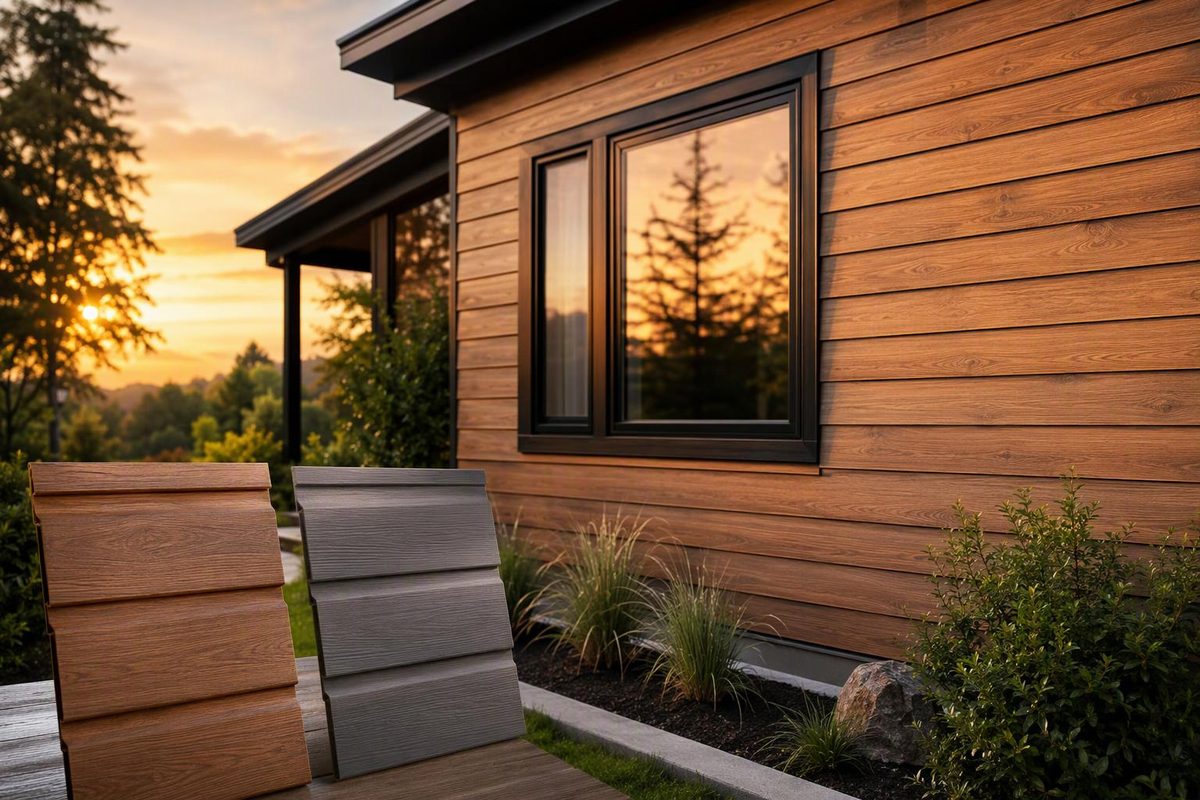
Metal siding that looks like wood can provide wood color and grain without routine staining, but steel and aluminum suit different houses and fail differently. Printed steel offers the broadest selection of traditional lap, plank, board-and-batten and log profiles. Extruded aluminum generally favors crisp architectural boards and battens. Choose by the profile, finish, wall assembly and warranty—not by the generic “wood-look metal” label.
Choose a profile and exposure concern; the tool will identify the closest options and the details to verify.
The Main Wood-Look Metal Options
| Type | Best Fit | Main Concern |
|---|---|---|
| Printed steel lap | Traditional houses | Dents and coating damage |
| Narrow steel plank | Modern houses and accents | Repeating print and visible trim |
| Steel board and batten | Farmhouse, cabin and gables | Flatness, layout and wind documentation |
| Steel log siding | Cabins and rustic houses | Specialized appearance and trim |
| Extruded aluminum boards | Contemporary houses and soffits | Finish care and specialized labor |
Quality Edge, for example, lists wood-grain Vesta steel planks as 5-inch-wide, 8-foot-long panels. Its TruCedar line includes traditional lap and vertical board-and-batten profiles. The systems use different steel thicknesses—0.020 inch for Vesta and 0.016 inch for the listed TruCedar profiles—showing why “metal siding” is not a sufficient specification (Quality Edge product specifications).
Longboard offers extruded aluminum lap and board-and-batten siding for residential work (Longboard siding). Local distribution and installer familiarity may narrow the practical choices even when a suitable profile exists.
Judge the Wood Look From Full Panels
A convincing color chip can still produce an artificial-looking wall. Review full-length physical samples and, if possible, a completed house before approving a finish.
- Pattern repetition: Determine how many distinct printed boards appear before the grain repeats. Vesta says six hand-drawn panel designs make up each of its wood-grain colors, so panel layout affects how obvious the repetition becomes (Vesta brochure).
- Sheen: A matte or low-sheen finish generally reads more like stained wood than a reflective coating.
- Depth: Printed color creates visual grain, while embossing and formed profiles create physical shadow. Neither reproduces the random checks, knots and board-to-board variation of cedar.
- Joints and corners: Metal corner posts, J-channel, seams and end caps can reveal the imitation more readily than the panel face.
- Context: Place the sample beside the roof, masonry, windows and trim, then view it from street distance. A digital rendering cannot reliably show sheen, relief or repeating grain.
Panel proportions matter as much as color. Narrow horizontal planks fit many contemporary façades, while conventional lap profiles look more familiar on traditional houses. A rounded steel log profile is an intentional cabin treatment, not a substitute for wood clapboards.
Steel and Aluminum Fail Differently
Steel offers several distinctly residential shapes in the product lines reviewed, including lap courses, deep battens, narrow planks and rounded logs. Its principal concerns are denting and damage to the protective coating.
No metal siding should be assumed dent-proof. Compare thickness or gauge, profile geometry, backing and product-specific impact reports instead of relying on a general “hail resistant” claim. The Insurance Institute for Business & Home Safety evaluates cladding materials and configurations because performance varies with both the product and its configuration (IBHS cladding study).
Wind documentation also requires a product-level check. Central States expressly says its Board & Batten panel has no documented certified testing and recommends a different panel when wind resistance or uplift testing matters (Central States Board & Batten). That warning does not apply automatically to every steel board-and-batten system. It demonstrates why a profile name is not proof of wind performance.
Steel depends on its protective coating and compatible installation details. Quality Edge’s Vesta instructions prohibit grinders and abrasive saws because they can damage the finish. The instructions also warn that hot cutting chips can harm the coating and require galvanized or stainless-steel fasteners rather than aluminum nails or staples. Steel siding must be separated from metals such as aluminum (Vesta installation guide).
Ask each installer how panels will be cut, how dissimilar metals will be isolated and how scratches or damaged edges will be treated. These details directly affect corrosion risk.
Extruded aluminum does not rust and can form crisp, rigid profiles, but its decorative coating still requires care. Salt and dirt can accumulate, particularly near the ocean. Longboard recommends annual cleaning and inspection in non-aggressive environments but every three months in coastal environments (Longboard care guide). That schedule applies to the cited Longboard system rather than every aluminum product.
The Wall Behind the Metal Still Manages Water
Metal panels do not rot, but they do not make the wall waterproof. Rain can pass behind exterior cladding, leaving the drainage plane, flashing and penetrations responsible for directing water out.
An itemized quote should identify:
- old-siding removal and disposal;
- sheathing inspection and repair allowances;
- the water-resistive barrier and flashing tapes;
- flashing at windows, doors and other penetrations;
- furring or rainscreen components required by the selected system;
- approved fasteners and the procedure for cut or damaged edges;
- corners, starter strips, transitions, soffits and custom trim;
- the touch-up procedure and quantity of spare panels supplied.
Vesta, for example, requires a flat, solid wall with at least 1/2-inch OSB or plywood, housewrap and flashed penetrations. Its instructions also direct installers to hang the panels loosely so they can move with temperature changes. Those requirements can increase labor and require correction of a wavy or damaged wall before installation.
Panel Price Is Not an Installed Budget
A price check on September 27, 2026, found TruLog steel board-and-batten listed at $4.25, $5.25 and $6.25 per square foot for three finish tiers (TruLog product page). These are one manufacturer’s posted product prices, not a national installed-cost range.
The draft research did not find consistent public bid data supporting a dependable installed range for this category. Freight, waste, trim, wall repairs, removal, flashing and labor can substantially change the total. Our metal board-and-batten comparison covers that pricing limitation in more detail.
Obtain at least two itemized local bids using the same product and wall scope. A lower panel price can lose its advantage when a system needs extensive custom trim or no local installer has experience with it.
Read Fire and Warranty Claims Narrowly
A steel or aluminum panel can have a noncombustible metal core without proving that the proposed wall assembly complies with local wildfire rules. Foam backing, weather barriers, insulation, sheathing, gaps and attachments may affect compliance.
In a wildfire zone, verify the exact listed or approved assembly and the applicable local code rather than relying on “Class A” marketing. Our state wildfire-siding guide explains where to begin.
Warranty headlines can combine unlike promises. Longboard’s Core residential warranty page lists 50-year coverage for structural aluminum profiles and 15-year coverage for the powder-coated finish, with removal and reinstallation excluded. Its other warranty tiers have different terms and eligibility (Longboard warranty).
Vesta’s registration certificate says the owner must register within 30 days after installation or the warranty is void (Vesta registration certificate). Confirm the current documents for the exact product you are buying.
Before signing a contract, separate these warranty terms:
- substrate, structural or perforation coverage;
- chalk, fade and adhesion limits;
- hail or impact coverage;
- coastal exclusions and cleaning duties;
- coverage for labor, removal, freight and refinishing;
- transfer rules and registration deadlines.
Specify the Exact System in the Contract
Approve a full-length sample and require the bid to name the panel profile, metal thickness or gauge, finish, trim, flashing, substrate preparation and warranty. If possible, inspect an older nearby installation for fading, dents, open joints, conspicuous repetition and trim workmanship.
The best choice is the specific system that looks credible on the house and has documented installation requirements, maintenance duties and failure risks you are prepared to accept. A broad promise of “metal siding that looks like wood” is not enough to compare bids.