
Fire Resistant Siding Requirements by State (2026)
Compare wildfire siding mandates in California, Colorado, Washington, Utah, and Oregon, then check maps, project scope, and replacement triggers.
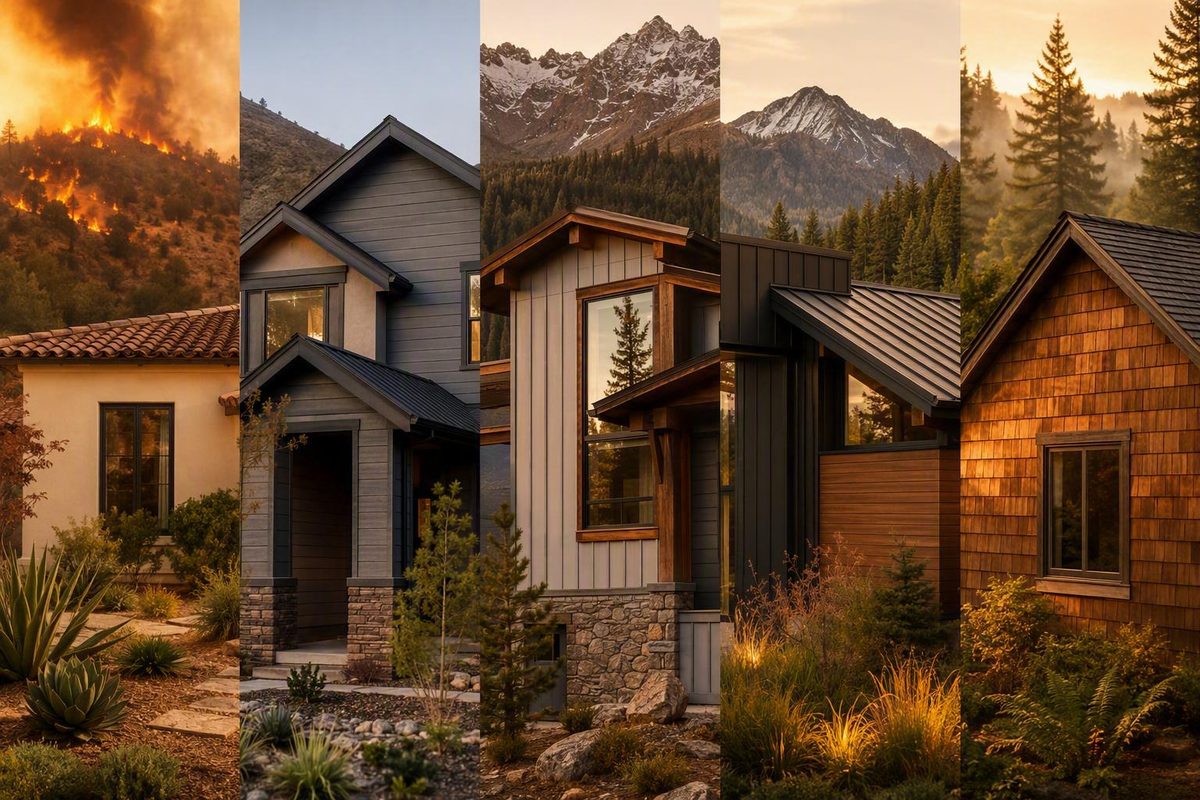
The verdict: the absence of a statewide siding mandate is not evidence of low wildfire risk. Washington reduced wildfire-code enforcement requirements in 2024, and fires near Spokane then destroyed about 700 structures and forced roughly 60,000 evacuations between August 2–4, 2026 (NPR/Houston Public Media; AOL/AP incident report). The incident report does not identify the siding, code status, or cause of loss for individual buildings, so it cannot prove that weaker rules caused those losses. It does show why “not required here” and “not at risk here” are different conclusions.
This guide provides general information, not legal, engineering, architectural, insurance, or permitting advice. Maps, code editions, local amendments, and enforcement practices change. Confirm the parcel and proposed wall assembly with the authority having jurisdiction before ordering materials.
Why Ordinary Siding Can Still Be A Rational Choice
The received view is understandable. Most homeowners do not select cladding from a state wildfire statute. They check what the building department permits, what contractors routinely install, and what insurance or financing requires. If ordinary wood or vinyl remains legal, it is reasonable to infer that the material is an accepted code option.
That inference is correct within limits. A state wildfire code may apply only to new construction, only inside a mapped wildland-urban interface (WUI), or only after an alteration reaches a stated threshold. A legal existing installation does not automatically require replacement. Combustible cladding may also qualify through a tested complete-wall assembly rather than through the facing alone.
The mistake is turning code silence into a hazard assessment. Washington’s 2024 change reduced enforcement requirements, while reporting says its revised approach still retained fire-resistant roof and siding provisions for new construction in mapped risk areas. Oregon repealed its wildfire building-code and vegetation-management rules in 2025 after public opposition; a 2023 law had also restricted insurers’ use of state wildfire maps. Those policy changes narrowed or complicated regulation without establishing that the underlying wildfire exposure had disappeared (NPR/Houston Public Media).
California and Colorado provide the opposite comparison: both have enforceable requirements in designated hazard areas. The Spokane disaster did not occur in either state, but that fact does not establish that their codes prevented a comparable loss. It only places the policy timelines side by side. No supplied study measures the share of the roughly 700 Spokane-area losses attributable to siding or compares otherwise identical homes under the different state systems.
Choose a state and enter your project measurements or actual siding quotes; the checker separates legal triggers, preparedness, and upfront price.
State labels are only a first screen. Select a state, describe the work, and enter actual quotes if you have them. Unknown figures remain — rather than being estimated.
Regional loss in supplied evidence: ~700 structures destroyed and ~60,000 evacuations near Spokane, August 2–4, 2026.
The reports do not identify each building’s siding, map status, construction date, or code compliance.
Needed to test Colorado’s 25% replacement threshold.
Colorado’s separate trigger is 500 sq. ft. or more.
| State | Mandate Status | Supported Trigger Or Scope | Loss Event In Evidence |
|---|---|---|---|
| Washington | Weakened/Limited Enforcement reduced in 2024; mapped rules reportedly retained | New construction in mapped risk areas; final implementation must be checked | ~700 structures; ~60,000 evacuations near Spokane, Aug. 2–4, 2026 |
| Oregon | Repealed Recent building and vegetation rules repealed in 2025 | Remaining state and local provisions are not established here | — in supplied evidence |
| California | Hard Mandate Chapter 7A framework in designated hazard areas | Mapped areas and covered construction; not every parcel statewide | — in supplied evidence |
| Colorado | Hard Mandate State Wildfire Resiliency Code | Designated WUI; 25% exterior-wall replacement and 500-sq.-ft. footprint triggers documented | — in supplied evidence |
| Utah | Adopted, Details Unknown | Precise siding criteria and geographic scope — | — in supplied evidence |
| Other States | Not Determined | Check state code, local amendments, WUI map, and project trigger | — in supplied evidence |
- A hard mandate can still be limited to mapped areas and covered projects.
- “Weakened,” “repealed,” or “not determined” does not mean the parcel has no local rule.
- The Spokane loss figure demonstrates exposure, not that siding or a code change caused individual losses.
- Quote fields use only your numbers; the supplied evidence contains no material-price figures.
- Local approval of the exact wall assembly controls legal compliance.
The Verified State Picture Is Narrower Than A 50-State List
There is no uniform national rule requiring fire-resistant siding. State minimums, local ordinances, hazard maps, project triggers, and complete-wall exceptions produce different answers even for similar houses.
| State | Current Supported Status | Where It Applies | Evidence Limit |
|---|---|---|---|
| California | Hard requirements in designated fire-hazard areas | Covered construction in mapped areas | Not every parcel or alteration |
| Colorado | State minimum WUI code | Designated WUI and intensity classes | Local rules may be stricter |
| Washington | Enforcement reduced; mapped rules reportedly retained | New construction in mapped risk areas | Final maps and local implementation control |
| Oregon | Recent statewide rules repealed in 2025 | Remaining state or local rules must be checked | Repeal is not proof of no local rule |
| Utah | Wildfire rules reportedly adopted | Scope not established by supplied evidence | Siding criteria remain undetermined |
| Other States | Not determined from available evidence | State or local coverage may exist | “Undetermined” does not mean “none” |
Ryan Maye Handy of Headwaters Economics described state wildfire regulation as “literally all over the map.” Research likewise finds multiple model-code and local approaches that regulate exterior walls alongside roofs, vents, glazing, doors, and installation details (Headwaters Economics).
The evidence does not support ranking a state as universally strict or lenient. A demanding provision with narrow map coverage may affect fewer homes than a strong county ordinance in a state without a broad mandate.
Washington’s Rule Was Weakened, Not Erased
Washington is the clearest warning against treating state status as a yes-or-no label. The 2024 legislation reduced wildfire-code enforcement requirements. Current reporting nevertheless says revised plans retained fire-resistant roof and siding requirements for new construction in mapped risk areas.
That does not establish a universal Washington mandate for noncombustible siding. It also does not establish that fire-resistant siding is optional on every parcel. The operative answer depends on the final hazard map, effective rules, project type, local implementation, and the proposed assembly.
The August 2026 incident establishes the scale of exposure, not the performance of a particular code provision. Reports put the loss at about 700 homes and businesses and evacuations at roughly 60,000. They do not say which buildings were inside mapped areas, when they were constructed, what siding they used, or whether they complied with a wildfire code.
Spokane Fire Department protection engineer Dave Kokot offered a similarly careful assessment of his own code-built home under comparable conditions: “You don’t know how the house would go through a fire, but I think ours would have done fine.” He also said these fires are “becoming much larger.” His statement supports hardening as risk reduction, not a guarantee that a compliant home survives.
Colorado Has The Clearest Verified Siding Triggers
Colorado’s 2025 Wildfire Resiliency Code establishes minimum requirements for covered buildings in designated WUI areas. Mapping comes first: the parcel’s WUI designation and fire-intensity classification determine which measures apply. The code supplements other building and fire requirements, and the most restrictive applicable provision governs.
For moderate- and high-intensity applications, exterior walls may need a qualifying noncombustible, ignition-resistant, fire-retardant-treated, heavy-timber, or fire-resistance-rated solution. That is not a universal approved-products list.
Garfield County illustrates how the state framework is administered locally. The county says siding replacement requires a building permit and asks applicants for manufacturer information demonstrating compliance. It also says vinyl may be permitted when the underlying wall assembly meets specified fire-resistance requirements (Garfield County siding guidance).
That does not make vinyl noncombustible. Approval can depend on sheathing, gypsum layers, substrate, weather barrier, fasteners, joints, penetrations, exposure direction, installation instructions, and a matching tested or listed design.
Replacing 25% Can Trigger The Entire Exterior Wall
Under the official Colorado code, replacement of 25% or more of the total exterior-wall surface area triggers the cited new-construction exterior-wall provisions. Once the threshold is reached, the entire exterior-wall surface area, including attachments, must comply with Sections 404.3 through 404.3.2. The immediate zone within five feet of the structure must also meet the referenced Section 503.1 requirement.
The statewide wording is “25% or more.” Garfield County’s summary uses “more than 25%,” but a project at exactly 25% should follow the inclusive state language unless the local authority provides a controlling interpretation.
Work affecting less than 25% is listed as exempt from this wildfire code. Other permits, local amendments, energy provisions, structural rules, or manufacturer requirements may still apply. Painting, staining, and similar maintenance are also listed as exempt.
A separate 500-square-foot trigger applies to an addition or alteration that increases a structure’s footprint by at least that amount. It does not refer to 500 square feet of siding or wall surface.
The code also lists an exemption for a one-story, detached, nonhabitable accessory structure no larger than 120 square feet when it stands at least 10 feet from the nearest occupiable structure. Definitions and local amendments can affect that result.
Before demolition, ask how the jurisdiction calculates total wall area, including openings, gables, garages, trim, attachments, storm damage, and phased work. Concealed deterioration that expands a planned repair from below 25% to 25% or more can change the compliance scope substantially.
California’s Requirements Depend On Maps And Project Scope
California has long-standing wildfire-resistant construction requirements in designated fire-hazard areas, but the supplied evidence does not support saying that every California house must have noncombustible siding.
Secondary reporting says California’s Chapter 7A provisions effective January 1, 2025, prohibit wood shakes and shingles in covered fire-hazard zones regardless of fire-retardant treatment. That is primarily a roofing rule, not proof that every exterior wall must use one specific cladding. The same secondary report says Colorado requires Class A roof coverings in WUI zones by July 1, 2026 (Yahoo Finance-carried manufacturer release). Because that item is a paid manufacturer release, it should not replace current code text or local review.
CAL FIRE’s home-hardening guidance is authoritative safety advice but is not automatically a permit requirement. It identifies damaged or combustible siding, roof-to-wall and deck-to-wall intersections, and exterior gaps or penetrations larger than 1/8 inch as vulnerabilities.
Its recommendations include repairing openings, considering noncombustible or ignition-resistant replacement material, and installing at least six inches of vertical metal flashing at deck-to-wall intersections. Where complete replacement is impractical, it suggests noncombustible siding on the lowest two feet of wall and metal flashing over the sheathing’s bottom edge (CAL FIRE home hardening).
Those measures reduce risk. They do not prove that a two-foot retrofit satisfies Chapter 7A or a local amendment. Conversely, voluntary guidance may call for protection beyond the minimum permit code.
Fire-Resistant Labels Do Not Establish Wall Compliance
“Fire resistant” is not one technical classification. Noncombustible material, ignition-resistant material, fire-retardant-treated wood, fire-resistance-rated construction, and Class A performance can refer to different tests and compliance paths.
Garfield County identifies ASTM E136 as one route for classifying material as noncombustible. Its guidance associates fire-retardant-treated wood with a flame-spread index of 25 or less under ASTM E84 or UL 723, followed by specified extended-test performance. Those are Colorado examples, not automatic nationwide definitions.
“Class A” needs the same caution. In the supplied material it appears prominently in roofing and flame-spread contexts. A Class A marketing statement does not by itself prove that siding meets an exterior-wall provision. The test method, product configuration, substrate, exposure, listing, and code section must match the proposed use.
A combustible facing may sometimes be accepted over a qualifying noncombustible or fire-resistance-rated wall. Compliance then belongs to the complete assembly, not to the visible siding alone.
Verify The Parcel Before Buying Siding
Start with the authority that will issue the permit. A mailing address may not identify the city, county, district, or state agency with jurisdiction.
Locate the parcel on the current official hazard map and save the map title, legend, classification, and revision date. Do not substitute an insurer score, evacuation map, real-estate graphic, or retailer risk tool for the map used in permitting.
Define the work precisely: new construction, maintenance, repair, recladding, reconstruction, addition, or movement of a building. Calculate exterior-wall area separately from footprint. Ask how openings, gables, garages, attachments, and phased work are counted.
Then obtain the controlling code edition, local amendments, WUI ordinance, effective-date notices, and applicable exterior-wall section. Confirm whether an appendix requires separate local adoption.
Submit the complete wall rather than a siding name. A useful package identifies the cladding, trim, sheathing, weather barrier, framing, insulation, gypsum layers, fasteners, joints, penetrations, flashing, test reports, listings, and manufacturer instructions. If compliance depends on a rated assembly, the proposed construction must match that design.
A retailer or manufacturer statement that a product “meets wildfire code” may refer to another test, substrate, code edition, or jurisdiction. Obtain the underlying report and written local approval where possible.
State status is only the first screening step. Washington demonstrates that reduced enforcement and serious wildfire exposure can coexist. Colorado shows how mapped coverage and a 25% replacement threshold can control an otherwise ordinary siding job. California shows why official safety recommendations and binding construction rules must be checked separately. Oregon’s repeal and Utah’s incompletely documented adoption both require fresh review of primary authority rather than assumptions based on a state label.