
Grey Vinyl Siding Spans Shades and Profiles
Digital swatches can create a shortlist, but they cannot show how a color will look across a wall beside your roof, brick, windows and landscaping.
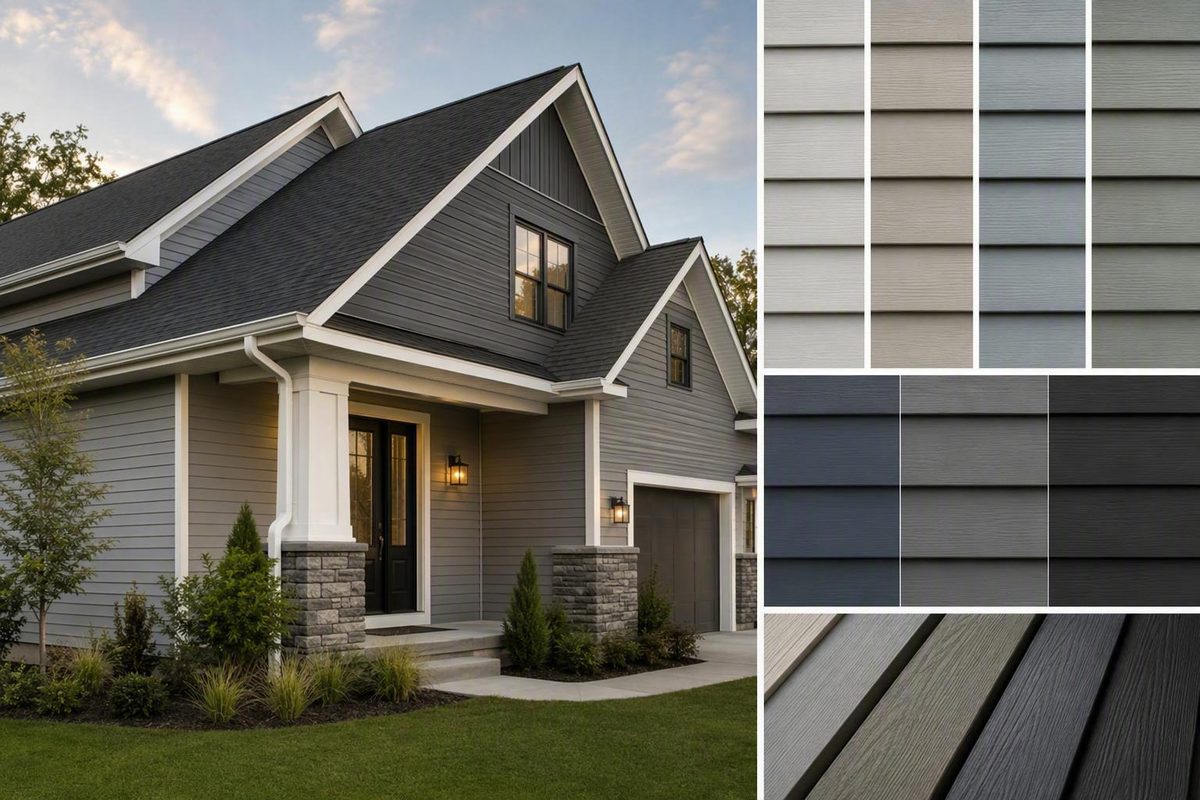
Grey vinyl siding is not one standardized color. The category includes pale silver, warm greige, blue-grey, green-tinged grey, slate, and deep charcoal, along with multiple profiles, package sizes, and product specifications.
That variety makes shopping by color name alone unreliable. The right choice depends on undertone, shade depth, profile, package coverage, fixed exterior materials, local availability, installation requirements, and warranty terms. Digital swatches can create a shortlist, but they cannot show exactly how a color will look across an entire wall beside your roof, brick, windows, and landscaping.
This guide uses both grey and the common US spelling gray. Manufacturer color names retain their official spelling.
Methodology and price date: The representative products and retailer prices below were reviewed on August 11, 2026. They are examples from the supplied manufacturer and retailer pages, not a complete market survey. Dynamic prices, stock, package details, and availability should be reconfirmed before purchase.
What “grey vinyl siding” includes
Start by separating shade depth from undertone.
Shade depth describes how light or dark a color appears. Undertone describes the less obvious color influencing the grey, such as blue, green, brown, or beige. Two samples can look equally grey indoors but react very differently beside red brick, beneath a black roof, or under a blue sky.
The main color families include:
- Light or silver grey: A pale option with relatively low visual weight and strong contrast against dark roofs or windows.
- Neutral mid-grey: A middle-depth grey without an immediately obvious warm or cool cast.
- Warm grey or greige: Grey influenced by beige, taupe, or brown.
- Blue-grey: A cool grey that may become more visibly blue in shade or beside warm masonry.
- Green-tinged grey: Grey with a subtle green cast that may become more noticeable around red brick, greenery, or blue-grey stone.
- Slate: Usually understood as a cool medium-to-dark grey, although the actual color varies by manufacturer.
- Dark charcoal or graphite: The deepest part of the category, sometimes approaching black but not necessarily matching another brand’s charcoal or graphite.
These are descriptive families, not industry color standards. Gray, Dove Gray, Sterling Gray, Granite Gray, Flint, Slate Gray, and Graphite can represent substantially different colors.
Norandex’s Dove Gray demonstrates why undertone matters. The manufacturer describes it as a light gray with subtle green hints and explicitly shows Great Barrier siding in that color. The same archive places Dove Gray in both its premium and green color groupings. However, the archive’s links to other exterior products do not prove that every linked profile is available in Dove Gray; availability still must be confirmed by product line and profile. See Norandex’s Dove Gray description and Great Barrier example.
Color is only half of the visual decision. Profile controls the siding’s proportions, orientation, seams, texture, and shadow lines. The principal formats in the reviewed grey listings are:
- Traditional clapboard: Horizontal courses with relatively simple, even faces.
- Dutch lap: Horizontal siding with a pronounced recessed or beveled shadow line.
- Cedar-style shake: Textured courses intended to reproduce the visual rhythm of individual shakes.
- Vertical or board-and-batten-related products: Panels that emphasize vertical rather than horizontal lines.
Profile can change how a shade reads from a distance.
Retail terminology is not always consistent. One Lowe’s grey-category listing used both board-and-batten and shake language for the same product. Treat retailer filters as candidate-finding tools, not definitive technical classifications. Before ordering, confirm the manufacturer’s profile name, orientation, exposure, dimensions, and installation literature.
Representative grey vinyl products and specifications
The following comparison shows the range of formats and purchase units a homeowner may encounter. All retailer-reported details were reviewed on August 11, 2026. Qualified or unstated fields prevent direct performance comparison, and retailer terminology should be checked against current manufacturer documents.
| Product | Official color | Profile | Panel or carton dimensions | Nominal thickness | Coverage | Displayed purchase unit | Listed price | Warranty or wind note |
|---|---|---|---|---|---|---|---|---|
| Georgia-Pacific Vision Pro Double 4-in Traditional | Gray | Traditional horizontal lap | 8 × 150 in. | Not stated | 8.33 sq. ft. | Per piece | $8.98 | Complete warranty and wind assembly not provided in the category listing |
| Georgia-Pacific Vision Pro Double 4-in Traditional | Gray | Traditional horizontal lap | Package dimensions not stated | Not stated | 200 sq. ft. | Retailer-reported 24-pack | $194.21 | Verify current product documents |
| Georgia-Pacific Vision Pro Double 5-in Traditional | Gray | Traditional horizontal lap | Package dimensions not stated | Not stated | 200 sq. ft. | Retailer-reported 20-pack | $201.96 | Verify current product documents |
| Georgia-Pacific Vision Pro Double 4-in Dutch lap | Gray | Dutch lap | Individual dimensions not fully supplied | Not stated | 8.33 sq. ft. | Per piece | $9.97 | Verify current product documents |
| Georgia-Pacific Vision Pro Double 5-in Dutch lap | Gray | Dutch lap | Package dimensions not stated | Not stated | 200 sq. ft. | Retailer-reported 20-pack | $201.96 | Verify current product documents |
| Georgia-Pacific Vision Pro 5-in Double Wide Traditional, ST5GR | Gray | Traditional double-wide lap | 10 in. × 12.5 ft.; 0.5-in. projection | 0.040 in. | Retailer says 10 pieces cover 100 sq. ft. | Displayed as a panel; package relationship unresolved | $12.59 | Retailer reports 165 mph and a limited lifetime transferable warranty when properly installed |
| Norandex Great Barrier | Dove Gray shown | Dutch lap and clapboard line | Extended panel lengths; profile-specific dimensions not supplied | 0.046 in. | Product-specific | Not stated | Not stated | Obtain current profile-specific installation and warranty documents |
| Sterling Gray cedar-style shake | Sterling Gray | Seller uses both vinyl-shake and polymer-shake terminology | Carton dimensions not stated | Not stated | 50 sq. ft., described as one-half square | Per carton | $157 | Seller’s summary addresses specified manufacturing defects under qualifying conditions |
The Georgia-Pacific Vision Pro traditional and Dutch-lap rows above come from Lowe’s location-dependent category snapshot. Review the Lowe’s grey siding listings and retailer qualifications.
The ST5GR dimensions, thickness, projection, coverage statement, wind figure, and warranty wording are retailer-reported rather than a substitute for manufacturer technical documents. Review the Lenco product page.
The Great Barrier specifications and Dove Gray example are manufacturer-reported, but exact dimensions and availability remain profile-specific. Review the Norandex color and product archive.
The Sterling Gray price, coverage, terminology, and warranty summary come from the seller’s product page. Review the Sterling Gray shake listing.
Lenco describes the ST5GR panel as fastening through a nailing flange or hem and connecting to adjoining pieces through an interlocking system. That is a product description, not a complete set of installation instructions. It does not establish fastening position, spacing, clearances, substrate requirements, water management, or allowance for panel movement.
Norandex identifies Great Barrier as a 0.046-inch Dutch-lap and clapboard line with a low-gloss woodgrain texture and extended panel lengths. Dove Gray is explicitly shown for Great Barrier, but the broader archive does not establish that every linked siding, shake, soffit, or porch-ceiling profile is offered in that color.
For homeowners seeking more texture than horizontal lap siding provides, the Sterling Gray shake carton covers 50 square feet. Because the seller uses both vinyl and polymer terminology, ask for the manufacturer, material specification, dimensions, installation manual, and complete warranty rather than relying on the category label.
Nominal thickness is useful identification information, but it does not independently establish impact resistance, wind performance, rigidity, color retention, or service life. A 0.046-inch line should not automatically be ranked above a 0.040-inch product without comparable testing and a review of the complete installed assembly.
What the listed material prices mean—and exclude
Every figure in this section is a retailer snapshot reviewed on August 11, 2026, not a current national market price. Local inventory, selected store, promotions, delivery area, purchase quantity, and later price changes can affect what a buyer pays.
Using the displayed Lowe’s prices and stated coverage:
- Double 4-inch Traditional Gray single panel: $8.98 ÷ 8.33 square feet = approximately $1.08 per square foot.
- Double 4-inch Traditional Gray pack: $194.21 ÷ 200 square feet = approximately $0.97 per square foot.
- Double 5-inch Traditional Gray pack: $201.96 ÷ 200 square feet = approximately $1.01 per square foot.
These calculations use Lowe’s displayed purchase units and coverage. Lowe’s also states that prices, promotions, styles, inventory, pickup, delivery, and service availability can vary by location. See the dated retailer listing used for the calculations.
The seller describes 50 square feet as one-half square, which implies the customary listing unit of one square equals 100 square feet. See the seller’s price and coverage statement.
Lenco displayed $12.59 for the cited 10-inch-by-12.5-foot panel and separately stated that 10 pieces cover 100 square feet. Do not convert those statements into a project rate until the seller confirms whether the displayed amount is per panel and whether the coverage statement describes the same purchase unit. A piece price can create a misleading comparison when another seller quotes by carton, pack, or square.
The shake and lap figures are not like-for-like installed-cost comparisons. They represent different profiles, purchase units, coverage, layouts, and likely waste patterns. Freight, taxes, accessory requirements, local stock, removal, and labor can also differ.
Panel-only prices generally exclude:
- Waste and package rounding
- Starter strip
- Inside and outside corners
- J-channel and utility trim
- Soffit and fascia
- Flashing and water-management work
- Housewrap or other water-resistive-barrier work
- Fasteners
- Removal and disposal
- Wall repairs
- Freight or local delivery
- Sales tax
- Permits and inspections
- Installation labor
Readers comparing vinyl with fiber cement, wood, metal, or engineered wood can also consult Siding Spot’s listed material-comparison article through the Siding Spot homepage. This is related first-party content, and the supplied evidence contained only its article listing—not the detailed cost analysis or independent verification of its methodology—so it does not support the retail calculations above.
Choose the undertone around the roof, masonry, and architecture
A practical color-selection sequence begins with the exterior materials that will remain:
- Identify the fixed elements. Include the roof, brick, stone, windows, permanent trim, porch flooring, chimney, and major wood features.
- Decide whether they lean warm or cool. Brown roofing, tan stone, cream trim, red brick, and many natural woods often read warm. Slate roofing, blue-grey stone, and some black finishes may read cool.
- Choose the desired contrast. Decide whether the siding should blend with those materials or create a pronounced light-dark difference.
- Compare named siding colors last. Use product names to identify samples, not to predict undertone or depth.
Roof and masonry starting points
A black roof is flexible but visually strong. Light or medium grey can create a restrained wall color while maintaining clear contrast with the roof. Charcoal can produce a darker overall composition, especially with black windows or trim. Neither is objectively better; test both against the house’s proportions and the amount of roof visible from the street.
With a slate-grey or cool-toned roof, begin with neutral grey, blue-grey, and other cool samples. Do not assume that siding named Slate will match the roofing. A coordinated difference is often easier to manage than an attempted near-match that is slightly wrong.
With brown roofing, tan stone, red brick, or natural wood, include warm grey and greige in the sample set. Cool blue-grey may still work, but the undertone contrast will be more apparent and should be deliberate.
Green-tinged grey deserves particular attention. Dove Gray’s documented green influence may appear restrained near vegetation, more visible beside red brick, or less coordinated with some blue-grey stones. A neutral-grey chip is not an adequate substitute when evaluating that specific color.
Trim, doors, and accents
White is the most consistently suggested neutral trim pairing for grey siding. It creates separation around windows, corners, columns, and rooflines. Cream can soften warm-grey siding, while black can produce stronger contrast. Navy, natural wood, and brighter door colors are optional accents rather than universal rules.
Voyager Exteriors suggests white, black, navy, cream, taupe, and natural wood with different grey families, while advising homeowners to consider roofing, sunlight, landscaping, and HOA requirements. These are commercial design suggestions, not product-performance findings. Review the contractor’s grey color guidance.
Do not choose trim in isolation. Account for:
- Window frames
- Exterior and garage doors
- Shutters, if present
- Gutters and downspouts
- Soffit and fascia
- Porch columns and railings
- Foundation color
- Hardscape and landscaping
- Nearby homes visible from the street
Architecture matrix
Architectural associations can narrow an overwhelming sample set, but they are subjective starting points rather than rules.
| House type or design goal | Grey families to test | Possible accents |
|---|---|---|
| Colonial or Cape Cod | Soft or light grey; restrained mid-grey | White trim; black or navy accents |
| Ranch | Warm grey, greige, or medium grey | Cream, wood, brick, or dark trim |
| Craftsman | Medium or warm grey | Stone, wood, cream, or black |
| Farmhouse | Warm grey or medium neutral grey | White, black, or natural wood |
| Coastal setting | Light grey or blue-grey | White trim and restrained blue accents |
| Modern or high-contrast scheme | Charcoal, graphite, or dark slate | Black, pale trim, wood, or metal accents |
These combinations address appearance, not durability or installation suitability. A charcoal Colonial or pale-grey modern house may work if its proportions and surrounding materials support the choice.
Mixed profiles can add contrast without introducing another color. Horizontal lap siding may be paired with shake in a gable or with a vertical accent near an entry or garage. Before designing around that approach, verify that the selected color is available across compatible lap, shake, vertical, corner, soffit, and trim systems. A color archive or retailer filter is not proof that every component can be ordered together.
Check HOA covenants and historic-district requirements before committing to a special-order or nonreturnable color. Restrictions may apply to siding, trim, shutters, doors, or contrast levels—not only the main wall color.
A repeatable way to test grey siding samples
Digital images are useful for eliminating colors you clearly dislike, but they are not reliable representations of a finished facade.
Use this sampling method:
- Shortlist two or three adjacent shades. Compare lighter and darker options, plus a warmer or cooler alternative where relevant.
- Obtain physical material. Full panels are preferable. If they are unavailable, request the largest samples the manufacturer or dealer can provide.
- Label every sample. Record the manufacturer, product line, official color, profile, and supplier.
- Mount samples vertically. Do not assess them flat on a table. Install them temporarily in their intended orientation so the profile casts realistic shadows.
- Place them beside fixed materials. Include the actual roof edge, brick, stone, window, trim, or wood that will remain.
- Test at least two elevations. North-, south-, east-, and west-facing walls receive different combinations of direct and reflected light.
- Inspect throughout the day. Look in the morning, around midday, late afternoon, and evening.
- Compare weather conditions. Direct sun, open shade, and overcast skies may expose different undertones.
- Step back. View samples at arm’s length and from the sidewalk or street. A color may read differently at facade scale.
- Replace unacceptable samples. If a sample repeatedly shifts toward blue, green, purple, or beige in a way you dislike, do not assume a full installation will correct it.
Thumbtack’s commercial color guide likewise advises coordinating physical samples with roofing, windows, doors, landscaping, and architecture while checking them under different lighting conditions. Review its exterior color-sampling guidance.
Take each image from the same position, use consistent settings where possible, and include the sample label.
Completed nearby houses may be more informative than small chips, especially when they use the same manufacturer, line, profile, and color. Confirm the product identity if possible. A similar-looking grey from another brand is not an exact reference, and roof color, landscaping, orientation, age, and surface condition can all change how the siding appears.
Estimate material quantity and build a complete budget
A per-panel price is not a material takeoff. Estimating requires measured wall areas, a consistent method for openings, an explicit waste allowance, and package rounding.
Use this workflow:
- Measure gross wall area. Divide the house into rectangles, triangles, and other manageable shapes.
- Handle openings consistently. Subtract windows and doors according to the estimator’s or manufacturer’s stated method.
- Establish net siding area.
- Add a visible waste allowance. Do not hide it within the package count.
- Separate profiles. Calculate lap, shake, and vertical accent areas independently.
- Round up to complete cartons or packs.
- Add accessories and non-panel work.
Illustrative quantity calculation
Assume a house has 1,800 square feet of net wall area after applying the chosen method for openings.
Using an illustrative 10% waste allowance:
- Net area: 1,800 square feet
- Assumed waste: 1,800 × 0.10 = 180 square feet
- Area before package rounding: 1,800 + 180 = 1,980 square feet
For siding sold in 200-square-foot packs:
- 1,980 ÷ 200 = 9.9 packs
- Round up to 10 packs
- Total ordered coverage: 2,000 square feet
For shake sold in 50-square-foot cartons:
- 1,980 ÷ 50 = 39.6 cartons
- Round up to 40 cartons
- Total ordered coverage: 2,000 square feet
The 10% allowance is an example, not a universal recommendation. Gables, dormers, bay windows, short walls, mixed profiles, layout patterns, panel lengths, damaged pieces, and installer practice can increase or decrease waste. Leftover lap siding also cannot be assumed to cover shake or vertical areas.
In the Sterling Gray listing, a 50-square-foot carton is described as one-half square. Do not assume every carton contains one square; always verify the stated package coverage.
Costs commonly missing from the panel figure
A complete siding budget may include:
- Starter strip
- Inside and outside corner posts
- J-channel
- Utility or undersill trim
- Window and door trim
- Soffit, fascia, vents, and porch-ceiling material
- Flashing
- Housewrap or other water-resistive-barrier work
- Fasteners and specified sealants
- Wall repairs and substrate preparation
- Removal and disposal of existing cladding
- Equipment, staging, or scaffolding
- Delivery and freight
- Sales tax
- Permits and inspections
- Labor
- Contractor overhead and warranty administration
Before comparing bids, verify whether each price is per piece, carton, pack, square, or installed square foot. Ask the supplier or contractor to state package coverage and package count explicitly.
Obtain a written takeoff and check local inventory before finalizing the color. A dealer may have enough wall panels but too few matching corners, J-channel, soffit pieces, or specialty accents. If future repairs are a concern, ask whether retaining clearly labeled spare material is appropriate.
Dark grey vinyl: availability, heat, fading, and alternatives
Medium and dark grey should not be treated as interchangeable. A standard color called Gray may be much lighter than Flint, Charcoal, or Graphite, but names alone do not establish color depth. Compare physical samples or manufacturer color information.
Commercial design sources present charcoal and graphite as design categories. By contrast, a March 2024 homeowner forum discussion reported difficulty finding vinyl as dark as James Hardie Iron Gray, with participants suggesting paint or fiber cement as alternatives. The thread is anecdotal and cannot establish market-wide availability or technical performance, but it illustrates the possible gap between a generic charcoal label and a particular very dark target. Read the forum discussion with those limitations in mind.
The supported general principle is that darker colors absorb more solar energy than lighter colors. The supplied evidence does not quantify panel temperature, movement, cooling effects, fade rate, warping risk, or service-life differences for any named grey vinyl product.
Do not turn that general principle into a claim that dark vinyl is universally unsafe or unsuitable. Before ordering charcoal vinyl for a hot, unshaded, or otherwise demanding exposure, request:
- The exact product’s technical bulletin
- Current installation instructions
- Approved color and exposure information
- Requirements for fastening and panel movement
- Any applicable hot-climate guidance
- The complete product and fade warranty
- Written confirmation that the proposed color and assembly are approved for the site
- Product-specific guidance for any unusual site exposure
The Lenco listing reports a 165 mph wind rating for its 0.040-inch Vision Pro panel, but the supplied page does not provide the substrate, fasteners, spacing, panel exposure, or other assembly requirements needed to interpret that figure. Do not assume it applies regardless of installation method. The retailer page reports the number but not the complete wind-rated assembly.
If an Iron Gray-like finish is the overriding priority, fiber cement is an alternative to investigate—not a proven superior choice for every house. Compare:
- Installed material and labor cost
- Structural and substrate requirements
- Cutting and handling methods
- Required tools and installer experience
- Joint, flashing, and water-management details
- Maintenance and repainting expectations
- Product and finish warranties
- Local availability and lead time
Painting existing vinyl may also be possible under product-specific constraints. The available guidance calls for cleaning and fully drying the siding, using paint formulated for vinyl, and working in suitable weather. It advises against applying a darker color unless the relevant siding or paint manufacturer permits it. Review the syndicated repainting precautions.
Approval matters because changing to a darker color may alter heat absorption or conflict with product requirements. Identify the existing siding manufacturer and product where possible, obtain written approval for the proposed paint system, and review warranty consequences before proceeding.
Pre-purchase checklist: installation, accessories, and warranty
A color decision is not complete until the product identity, purchase details, installation requirements, and warranty are documented.
Product identity
Put the following in the quote or order:
- Manufacturer
- Product line
- Official color name
- Profile and orientation
- Panel exposure
- Panel length and width
- Nominal thickness
- Projection, where applicable
- Package coverage
- Pieces per carton or pack
- Purchase unit
- Total package count
- Product or SKU number
This prevents a broad request for “gray double-four siding” from being filled with a substitute that has a different undertone, texture, profile, or specification.
Inventory and delivery
Confirm:
- Current local stock
- Lead time
- Whether the order is special or nonreturnable
- Freight and delivery charges
- Damaged-material procedures
- Restocking fees
- Return rules for unopened cartons
- Whether compatible production stock matters to the supplier
- How replacement material can be identified later
Do not assume that every accessory shown in a color family is stocked locally.
Matching components
Verify the availability and exact color of:
- Inside and outside corners
- J-channel
- Starter strip
- Utility trim
- Soffit and fascia
- Vents
- Shakes or shingles
- Vertical accents
- Porch-ceiling panels
- Mounting blocks and other visible accessories
Contrasting trim may be a reasonable design choice, but it should be intentional—not a last-minute response to unavailable matching components.
Installation documents
Request the current manufacturer installation manual rather than relying on a retailer description. The contractor should identify requirements for:
- Substrate condition
- Water-resistive barrier and drainage
- Flashing
- Fastener type and corrosion resistance
- Fastener placement
- Spacing and clearances
- Panel movement
- Overlaps and seams
- Openings and penetrations
- Wind-rated assemblies
- Local code compliance
A nailing hem and interlocking connection explain how panels attach and connect, but they do not define the complete wall assembly.
Warranty review
Request the complete warranty. Product-page phrases such as “limited lifetime” or “transferable” do not reveal the scope of protection.
Check:
- Who qualifies as a covered owner
- How “lifetime” is defined
- Transfer rules and deadlines
- Definitions of manufacturing defects
- Definitions or thresholds for excessive fading
- Exclusions for normal weathering
- Installation-compliance requirements
- Cleaning and maintenance obligations
- Climate or exposure exclusions
- Labor and removal coverage
- Replacement-material coverage
- Proration
- Color-match limitations
- Claim documentation and deadlines
- Consequential-damage exclusions
Lenco states that the cited Georgia-Pacific product has a limited lifetime transferable warranty when properly installed, but the retailer page does not include the complete terms. That summary should not be read as proof of labor, removal, fade, color-match, or subsequent-owner coverage.
For Sterling Gray shake, the seller’s linked summary addresses specified manufacturing defects—including peeling, flaking, blistering, and corroding—under proper use and exposure conditions. The complete limitations remain in the warranty document, so the summary does not establish universal labor, removal, fading, or replacement coverage.
Confirm whether professional installation is available locally and whether installer qualifications, registration, photographs, receipts, or other records affect warranty eligibility. The reviewed product pages do not resolve those questions.
Obtain HOA or historic-district approval before ordering a special or nonreturnable color.
Bid-comparison template
Ask every bidder to complete the same fields:
| Bid item | Contractor or supplier response |
|---|---|
| Net siding area | |
| Waste percentage and reason | |
| Area after waste | |
| Product and package coverage | |
| Package count | |
| Lap, shake, and vertical areas | |
| Accessories included | |
| Removal and disposal | |
| Wall or substrate repairs | |
| Water-management and flashing work | |
| Soffit and fascia | |
| Delivery and freight | |
| Taxes | |
| Labor | |
| Permit and inspection costs | |
| Installation manual and version | |
| Warranty and registration | |
| Exclusions and allowances | |
| Total installed price |
Frequently asked questions
Is grey vinyl siding more expensive than other vinyl siding colors?
Not necessarily. The reviewed snapshots show prices for particular products, profiles, and package sizes; they do not prove that grey carries a general color premium.
In the cited listings, traditional lap material was displayed near $1 per square foot of coverage, while Sterling Gray cedar-style shake calculated to $3.14 per square foot. That is mainly a comparison between different products and formats, not evidence that Sterling Gray costs more simply because it is grey.
Compare the same manufacturer, product line, profile, thickness, coverage, purchase unit, and delivery location. Also ask whether a dark or premium color belongs to a separate pricing tier.
Does dark grey vinyl siding get hotter or fade faster than light grey?
Darker colors generally absorb more solar energy than lighter colors. The available evidence does not quantify how much hotter a named charcoal panel becomes or establish a specific difference in expansion, fading, warping, cooling demand, or service life.
Request product-specific technical information, approved exposure guidance, installation instructions, and warranty terms. Climate, wall orientation, formulation, installation, and local exposure may affect the answer. A generic warning does not prove that all dark-grey vinyl will fail, while a marketing label does not prove suitability for every site.
What trim and roof colors work with grey vinyl siding?
White is the most broadly suggested trim choice. Black, navy, cream, taupe, natural wood, and brighter front doors can also create contrast.
With a black roof, test light, medium, and charcoal greys at full scale. For slate or another cool roof, include neutral and blue-grey samples. With brown roofing, tan stone, red brick, or natural wood, compare warm grey and greige with cooler alternatives.
These are design starting points rather than rules. The best combination depends on undertone, house proportions, windows, masonry, landscaping, and the amount of roof visible.
Can existing vinyl siding be painted grey or charcoal?
Potentially, but the siding’s condition and the manufacturers’ requirements control the decision. The surface generally must be properly cleaned and dried, and the coating must be formulated for vinyl and applied under suitable conditions.
Do not paint existing vinyl a darker grey or charcoal unless the relevant siding and paint manufacturers permit it. Confirm preparation, approved colors, application conditions, and warranty effects in writing.
Is 0.046-inch vinyl siding better than 0.040-inch siding?
Thickness alone is not enough to reach that conclusion. Norandex identifies Great Barrier as 0.046 inch, while the cited Lenco Vision Pro panel is listed at 0.040 inch. Those figures identify nominal thickness but do not provide a controlled comparison of rigidity, impact resistance, wind performance, fading, or service life.
Compare complete product specifications, panel geometry, profile, testing documentation, required installation assembly, warranty, local exposure, and the contractor’s installation plan—not just the thickness number.
Final decision path: Shortlist grey families according to the roof and masonry undertones, compare named products by profile and package coverage, test large physical samples on the house, calculate complete packaged quantities and project extras, and verify current installation instructions and warranty terms. The right grey is the product-specific option that fits the home, local exposure, budget, and documented installation requirements—not simply the most appealing online swatch.