
Celect Siding vs Hardie: Cost, Climate, and Upkeep
Compare cellular PVC and fiber cement by local bids, coastal exposure, fire requirements, repainting, repairs, installation, and warranty terms.
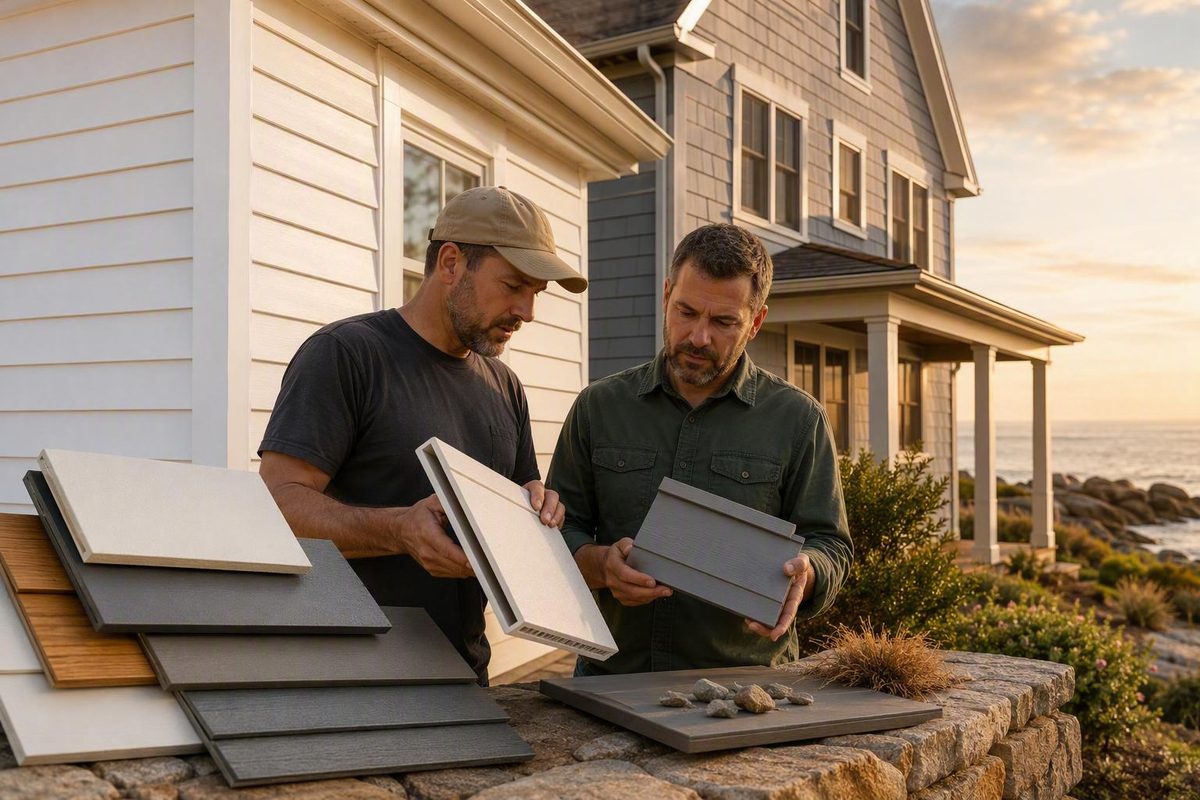
Celect is the better shortlist when moisture-resistant cellular PVC, less-visible interlocking joints, and reduced panel-joint caulking matter most. Hardie is the better starting point when noncombustibility or fire-code fit leads the decision. Neither has a proven universal advantage in installed cost or durability, so compare qualified local bids, wall details, upkeep, and repair access before choosing.
| Decision | Celect | Hardie |
|---|---|---|
| Material | Cellular-PVC composite | Fiber cement |
| Joints | Interlocking system | Detailed butt joints |
| Leading strength | Moisture-resistant material | Noncombustibility |
| Main cost uncertainty | Material and crew familiarity | Handling, cutting, finishing |
Enter your wall area and local cost assumptions; the calculator shows installed and 20-year totals without inventing national prices.
No reliable national price range or repaint interval is available in the cited evidence. Enter comparable local bid rates and your own upkeep allowances; unknown values remain —.
| Option | Installed Range | 20-Year Upkeep | 20-Year Total |
|---|---|---|---|
| Celect | — | — | — |
| Hardie | — | — | — |
- Celect: locking joints may reduce panel-joint caulking, but openings and transitions can still require sealant.
- Hardie: allow for caulk inspection, touch-up, and possible refinishing according to the exact finish and instructions.
- Reported service-life estimates are approximately 30–40 years for Celect and up to 50 years for properly installed and maintained Hardie; these are contractor estimates, not guarantees.
- Celect’s advertised wind claim is up to 210 mph, but the cited material does not supply the configuration details needed to apply it to a house.
Source note: figures and limitations come from the article’s cited manufacturer announcements, Consumer Reports methodology, and contractor guidance. Installed rates, upkeep costs, and climate premiums are not supplied by that evidence and must be entered by the user.
The available evidence does not establish reliable national installed-price ranges for this comparison. Celect material may cost more, while Hardie’s weight, cutting, dust controls, fastening, joint work, and finishing can raise labor. The calculator therefore requires actual bid rates and upkeep assumptions rather than presenting unsupported averages.
Celect is a lighter, plastic-based panel system. Hardie is a heavier cement-based board generally described as a mixture of cement, sand, and cellulose fibers. Those differences affect movement, cutting, fastening, joints, fire classification, and future repairs.
Westlake Royal describes Celect as cellular PVC composite siding with an interlocking gravity-lock design intended to create tight, less-obvious joints (Westlake Royal’s Celect announcement). The joints may create a more continuous appearance and reduce panel-to-panel caulking. They do not make the wall waterproof; flashing, drainage, the weather barrier, and specified sealants remain necessary.
Consumer Reports says its siding evaluations include ultraviolet color change, impacts at 0°F and 70°F, and attachment under simulated wind. Its available buying guide names Celect and Hardie products but does not disclose scores that establish a winner (Consumer Reports siding buying guide).
Installed Cost Depends on the House and Crew
There is no defensible universal Celect-versus-Hardie installed cost per square foot in the supplied evidence. Contractor comparisons use different scopes, regions, wall designs, accessories, and labor assumptions.
The recurring pattern is that Celect material can be more expensive, while Hardie can require more labor for lifting, staging, cutting, fastening, dust control, joints, edge treatment, and touch-up. One contractor described total project costs as broadly comparable despite the different cost components (AIC Roofing’s material comparison). That observation is not a national price benchmark.
Celect’s light, locking panels may move quickly across simple wall fields. Its trim sequence, custom corners, window casings, and unfamiliar installation details can erase that advantage on a complicated exterior. A crew that installs Hardie every week may complete it more efficiently than a crew learning Celect on the job.
Wall area alone cannot explain the quote. Windows, doors, corners, gables, roof intersections, decks, masonry, mixed orientations, tear-off, hidden sheathing damage, trim, lifts, permits, painting, and disposal all change labor and material quantities.
Every bid should cover the same measured wall area and written scope. Separate tear-off, weather barrier, flashing, drainage components, siding, trim, fasteners, sealants, painting or touch-up, access equipment, disposal, permits, spare material, and sheathing-repair unit prices. If one quote omits window flashing or lift access, its lower total does not demonstrate that its siding is cheaper.
Compare 20-year ownership cost with local assumptions. Celect is positioned as factory-finished and low maintenance, but low maintenance does not mean no cleaning, inspection, sealant work, or storm repair. Hardie may require cleaning, inspection of caulked transitions, touch-up, and eventual refinishing. The evidence supplies no universal repaint interval or upkeep price, so those entries must come from the bidder, painter, manufacturer instructions, and conditions at the house.
Coastal Moisture Favors Celect’s Material, Not a Waterproof Claim
Celect’s cellular-PVC construction makes it an appealing candidate in wet and salt-air locations. Unlike a cement-based board, the panel itself is positioned for moisture resistance. Its locking joints may also reduce conspicuous seams.
Salt air changes more than the siding choice. The specification must identify corrosion-resistant fasteners and accessories, flashing at windows and doors, kickout flashing, drainage behind the cladding, treatment of penetrations, and clearances above roofs, paving, and soil. Wind-driven rain is especially demanding at corners and openings.
Hardie is not automatically unsuitable for wet or freeze-thaw climates. Its performance depends on dry storage, intact coatings, correct cut-edge treatment, fastening, joint detailing, flashing, drainage, and required clearances. Poor execution increases moisture risk, but it does not prove that fiber cement inevitably fails in rain or snow. See Fiber Cement Siding Is Durable, but It Is Not Waterproof.
Thermal movement also needs product-specific detailing. Celect’s PVC-based panels and Hardie’s fiber-cement boards do not move or connect in the same way. Celect depends on correct engagement, fastening, and allowances required by its panel system. Hardie depends on its specified fastening and joint details. Neither should be installed using habits borrowed from the other material.
For a coastal house, Celect earns the first estimate when moisture-resistant material and concealed-looking seams dominate. Hardie remains a candidate when an experienced crew can document the complete drainage assembly, edge treatment, fasteners, and clearances. In either case, verify wind documentation for the exact substrate and fastening schedule.
Fire-Sensitive Sites Give Hardie the Clearer Starting Point
Fiber cement is described in the supplied evidence as noncombustible, giving Hardie the clearer material-level advantage when verified fire performance leads the project (NorthCo’s Celect and Hardie comparison). Celect is PVC-based.
Noncombustible does not mean fireproof, and a noncombustible board does not make the complete exterior noncombustible. Sheathing, weather barriers, insulation, trim, soffits, vents, decks, windows, attachments, and nearby vegetation remain part of the risk.
Before specifying Hardie for a wildfire or code-sensitive site, obtain the exact product classification and any required listed wall assembly. The building department, designer, or fire authority should confirm local wildland-urban-interface rules and whether the proposed trim, soffits, vents, and attachments qualify. A general statement that fiber cement resists fire is not a substitute for approval of the actual assembly.
Wind, Hail, and Freeze-Thaw Claims Need Test Details
Westlake Royal claims Celect can resist winds up to 210 mph. The supplied announcement does not identify the test standard, substrate, fastener schedule, exposure category, wall assembly, or other conditions behind that figure. It is a manufacturer claim, not a guarantee for every Celect installation.
For either product, request the applicable test or evaluation report and have the contractor identify the substrate, fastener type, spacing, starter details, corner-zone requirements, and building-height limits. Homes near open water, on ridges, or in hurricane regions may face pressures that differ from sheltered inland walls.
The available Consumer Reports guide confirms that low-temperature and warm-temperature impact testing forms part of its siding evaluation, but it does not reveal comparative Celect and Hardie results. Homeowners in hail or severe-cold regions should request product-specific impact documentation, warranty exclusions, and a written repair method.
A useful impact comparison identifies the test temperature, projectile or force, supporting assembly, and whether the result concerns cosmetic damage, cracking, or loss of function. It should also explain whether a damaged middle panel or board can be replaced without dismantling extensive trim.
Celect Reduces Some Upkeep but Hardie Can Be Refinished
Celect’s factory-finished surface and locking joints are intended to reduce recurring work, particularly caulking between siding panels. Sealant may still be required at openings, penetrations, trim, and transitions. Those locations should be shown in the installation instructions and contract.
Hardie upkeep depends on the finish, exposure, workmanship, and current manufacturer guidance. Cleaning, sealant inspection, localized touch-up, and eventual repainting or refinishing may be required. Excessive or poorly matched touch-up can leave visible spots because field-applied material may weather differently from a factory finish, according to a contractor’s installation-error guide (Blue Jay Exterior Renovations).
Repainting is also a practical difference rather than an automatic disadvantage. A repaintable fiber-cement exterior gives an owner a route to renew or change the finish. Celect’s factory color reduces that expected task, but a future damaged panel must be matched to the weathered installation and available product stock.
One contractor comparison estimates approximately 30–40 years for Celect and up to 50 years for properly installed and maintained Hardie (Smart Exteriors’ comparison). These are conditional, non-independent estimates, not tested service lives, warranty promises, or guarantees.
Warranty duration should not be treated as predicted lifespan. Westlake Royal advertises 25-year limited color protection for Celect. Secondary contractor sources commonly report 30-year Hardie product coverage, sometimes with separate, shorter finish coverage. Current complete warranties for the exact product, finish, location, and purchase must control; the secondary reports do not verify current terms.
Repair Access Can Reverse the Apparent Value
A low-maintenance product can still be expensive to own if a storm-damaged piece is difficult to replace. Ask each installer to explain how a panel or board in the middle of a wall is removed, what surrounding siding or trim must come off, and whether the weather barrier is likely to be disturbed.
Celect’s connected panel system may affect the removal sequence. Hardie’s individual boards can still be difficult to extract around blind fastening, butt joints, trim, or delicate surrounding pieces. Neither system is automatically easier in every wall configuration.
The repair plan should state expected access equipment, labor, finish matching, weather-barrier repair, and replacement-stock source. Retaining spare siding and trim from the original order can be more useful than relying on a future color match. Confirm that a local distributor stocks the selected profile and accessories rather than only accepting special orders.
Installer Experience Is Part of the Product
Celect and Hardie fail in different ways when crews apply the wrong sequence or details. Celect installation depends on correctly engaged panels and coordinated trim. A contractor description notes that some corners, trim, and window casings may follow a sequence unlike conventional lap siding, adding labor around detailed elevations (Carlson Exteriors’ Celect discussion).
Hardie work requires dry storage, controlled cutting, silica-dust protection for workers, correct fasteners, specified butt-joint treatment, required clearances, flashing, drainage, edge treatment, and restrained touch-up. Contractor guidance reports 12-foot HardiePlank boards and describes a 6-inch weather-resistant slip sheet behind butt joints in Canadian installations. Those dimensions must be checked against the current manual for the exact product and jurisdiction.
Ask how many projects the assigned crew has completed using the exact profile and trim system—not how many siding jobs the company advertises. References should come from comparable houses with similar window counts, corners, stories, and exposure.
The contract should identify the governing installation manual, substrate, weather barrier, drainage strategy, flashing sequence, fasteners, joint treatment, sealant locations, cut-edge procedure, dust controls, repair method, inspections, and responsibility if workmanship invalidates manufacturer coverage.
New Celect Profiles Expand the Design Choice
Westlake Royal added a 12-foot Celect V-Groove profile for horizontal or vertical installation in the United States and Canada in February 2026. It later introduced coastal-inspired colors on August 12, 2026. The announced palette includes Coral Reef, Cottage Green, Peachy Keen, Sea Blue, and Sunkissed Yellow (LBM Journal’s Celect announcement).
These announcements document product additions, not comparative performance. Older contractor sources generally describe Hardie as having a broad range of colors, textures, reveals, and profiles, but local catalogs and inventory change. It is not safe to claim that either line always has more choices.
Inspect full-size installed examples rather than relying on a small sample. Celect’s joints are intended to be less visible, not invisible. Wall length, lighting, installation tolerances, viewing angle, and trim placement can reveal seams. On Hardie, inspect butt joints, waviness, touch-up marks, and the proportions of boards and trim.
The Final Choice Splits by Priority
| Dominant Requirement | First Shortlist | Verify Before Buying |
|---|---|---|
| Fire-code fit | Hardie | Classification and assembly |
| Coastal moisture | Celect | Drainage, fasteners, wind details |
| Concealed joints | Celect | Installed appearance and repair |
| Refinishable surface | Hardie | Finish and repaint requirements |
| Lowest total quote | Either | Identical itemized scope |
Choose Hardie first for a fire-sensitive project, provided the exact assembly satisfies local requirements. Choose Celect first for a wet or coastal replacement where cellular PVC, locking joints, and reduced panel-joint caulking outweigh the need for a noncombustible cladding.
For a freeze-thaw or hail-prone house, neither material wins from composition alone. Compare low-temperature impact evidence, drainage details, coatings, cut edges, clearances, warranty exclusions, and repair logistics. For a budget-led project, use comparable bids and your own 20-year maintenance assumptions; the evidence does not support a universal cost winner.
Before signing, obtain the current product data sheet, regional installation manual, complete product and finish warranties, maintenance instructions, applicable code report, fire documentation, wind report, and impact information. Save the versions incorporated into the contract because online documents can change.
For broader material context, compare house-siding costs, lifespan, maintenance, and common failure modes.