
Hail Damage Siding Claim Denied: What to Document
Learn why insurers reject or limit siding hail claims, how to map damage by elevation, and which records support a focused reinspection request.
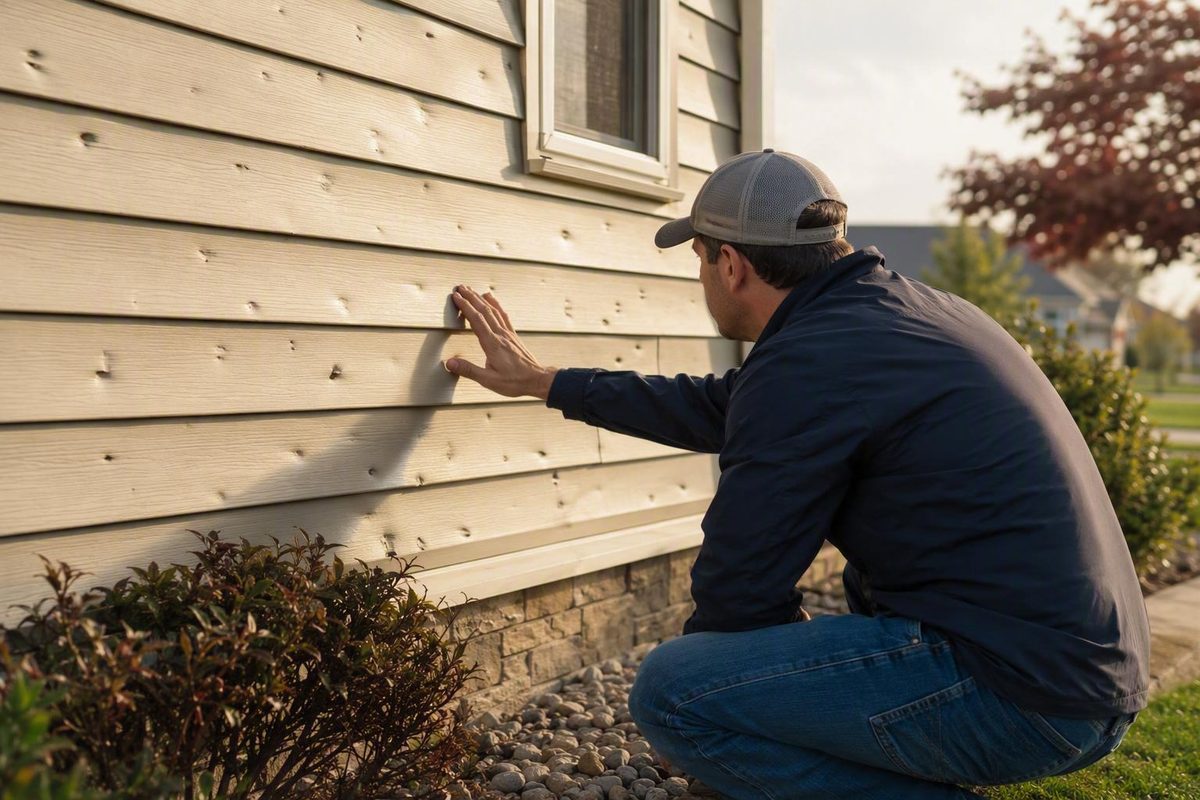
A denied siding hail claim often turns on one of four findings: the marks are not from hail, they are cosmetic rather than functional, only certain panels or elevations qualify, or undamaged siding is excluded from matching replacement. First identify which finding the insurer made, then answer it with policy language and location-specific evidence before requesting a reinspection. A damaged roof, totaled car, or paid neighboring claim proves storm context—not covered damage to your siding.
Choose your siding, enter the reported hail size and observed hits for each wall, then use the result to organize—not prove—your reinspection request.
Record reported hail size and impacts within one 100 sq. ft. test area on each elevation. Then classify the observed physical effect. Counts organize evidence; they do not establish coverage.
| Elevation | Hits / 100 sq. ft. | Strongest Observed Effect | Evidence Flag |
|---|---|---|---|
| Front | No effect recorded | ||
| Rear | No effect recorded | ||
| Left | No effect recorded | ||
| Right | No effect recorded |
How flags work: “Appearance-only” applies only when that observation is selected. Cracks, chips, punctures, and loose or displaced panels are flagged for functional review—not declared covered damage. No numeric hit threshold is applied because the supplied sources establish none for siding.
Source note: classifications and limitations reflect the article’s policy and documentation guidance; hail size and hit counts are homeowner-entered. American Family’s cited guidance describes coverage as subject to policy terms and deductibles.
The tool does not apply a universal coverage threshold. The supplied evidence establishes no industry-wide number of hits per 100 square feet that proves functional siding damage. Its useful output is a consistent elevation-by-elevation record showing where impacts were counted, what physical effects were observed, and whether matching coverage may become relevant.
Determine What the Insurer Actually Decided
Direct physical hail damage to siding may be covered, but the individual policy controls. Coverage and payment depend on its language, endorsements, exclusions, deductible, limits, evidence, facts of loss, and governing state law. American Family says dwelling coverage typically helps repair or replace hail-damaged parts of a home, subject to the deductible and policy terms (American Family’s hail-coverage guidance).
“No payment” does not necessarily mean “denied.” Classify the result before disputing it:
- Complete denial: The insurer found no covered hail damage, applied an exclusion, or said a policy condition was unmet.
- Partial approval: It accepted damage in some locations but not others.
- Scope dispute: It approved certain panels, while you contend that a course, elevation, or larger area requires replacement.
- Matching dispute: It accepted directly damaged panels but excluded undamaged siding needed for a closer visual match.
- Valuation dispute: The parties agree covered damage exists but disagree about quantities, labor, materials, or depreciation.
- Below-deductible result: The accepted estimate does not exceed the applicable deductible, so no payment is issued.
Collect the decision letter, insurer estimate, payment or depreciation worksheet, declarations page effective on the loss date, complete policy, every endorsement and deductible schedule, photographs, inspection reports, estimates, and correspondence.
Read the decision letter beside the policy. Copy every stated reason and cited provision into a worksheet. Review the complete definitions, exclusions, exceptions, conditions, and endorsements rather than relying on a phrase such as “wear and tear.”
Search for “direct physical loss,” “windstorm or hail,” “cosmetic damage,” “marring,” “wear and tear,” “deterioration,” “actual cash value,” “replacement cost,” “wind or hail deductible,” “matching,” “siding replacement,” “pair or set,” “duties after loss,” “proof of loss,” “appraisal,” and lawsuit-limitation language.
If the decision remains unclear, ask in writing what physical observations supported it, what photographs and weather information were considered, which exact provisions apply, and whether the decision concerns every elevation or only specified panels. Ask whether the finding is no hail impact, cosmetic impact, excluded damage, or covered damage below the deductible.
Verify notice, proof-of-loss, reconsideration, appraisal, complaint, and lawsuit deadlines promptly. No single deadline applies nationwide.
Match Each Denial Reason to Specific Evidence
A weather report showing hail nearby does not establish that a particular siding mark came from that storm. Address the insurer’s stated reason directly.
| Stated Reason | Evidence to Assemble | Focused Response |
|---|---|---|
| No hail damage | Storm chronology, dated and pre-loss photos, inspection findings | Request a location-by-location reinspection |
| Wear or deterioration | Older photos, maintenance and installation records | Obtain material-specific causation findings |
| Cosmetic only | Endorsement, close photos, evidence of cracking, puncturing, splitting, or loosened attachment | Ask which wording applies to each effect |
| Inadequate proof | Labeled photo log, damage map, product ID, itemized estimate | Submit an organized supplement |
| Below deductible | Estimate, declarations, deductible endorsement | Check scope and deductible calculation |
| Limited scope | Measurements, damage map, repair method, access analysis | Reconcile estimates by elevation |
| No matching coverage | Endorsement, availability search, product data, samples | Separate direct damage from matching |
A cosmetic dispute contains two questions: did hail cause the mark, and does the policy cover that type of physical change? Proof of causation does not resolve coverage. If you contend that serviceability is affected, identify the exact condition—cracking, chipping, puncturing, splitting, or loosened attachment—and its location.
Do not present a contractor’s internal impact count or a roof test-square rule as an authoritative siding standard. The supplied evidence establishes no universal inspection threshold across vinyl, metal, fiber cement, wood, and engineered wood products.
For alleged wear or pre-existing damage, use older real-estate photographs, inspection images, maintenance invoices, and installation records to distinguish recent impact effects from fading, oxidation, warping, brittleness, installation marks, or gradual deterioration.
If proof was called inadequate, improve its structure rather than merely adding files. For every disputed location, provide an overview, a medium-distance image, a close-up, and a short factual observation.
Build an Elevation-by-Elevation Damage File
Create a chronology containing the storm date and approximate time, available weather information, discovery date, notice date, inspection dates, submissions, decisions, and payments. After calls, record the date, participants, and principal points. When practical, confirm your understanding by email.
Photograph the front, rear, left, and right elevations. Follow each overview with medium views locating a panel relative to a window, corner, utility fixture, or course, then close-ups of the physical condition. Label each file with the elevation, panel or landmark, date, observed mark, and whether that location was accepted or disputed.
If chalk or removable tape identifies impacts, retain an unmarked photograph of the same location. Do not climb or enter unsafe areas. Document conditions before temporary protective measures when safely possible, preserve receipts, and follow the policy’s mitigation instructions.
Identify whether the material is vinyl, metal, fiber cement, wood, or engineered wood. Record the approximate age, manufacturer, product line or profile, dimensions or gauge, color, texture, fastening system, damaged-panel locations, and apparent availability of matching stock.
Hail may dent, crack, chip, or puncture siding, but the supplied evidence establishes no universal inspection standard for every material or product. Ask an evaluator to separate observations from conclusions and explain where each mark is, what changed physically, whether the panel appears serviceable, what repair is proposed, and what uncertainty remains.
A contractor can document repair methods, pricing, product availability, and risks to adjacent panels. Because a contractor expecting to perform the work has a commercial interest, treat the opinion as evidence rather than a binding coverage decision.
Separate Functional Damage From Appearance Changes
“Cosmetic” generally describes an appearance change that the insurer concludes does not impair performance. “Functional” is a claim-specific finding that the impact affected the siding’s serviceability or physical integrity. The applicable policy may define or limit these concepts differently.
Do not rely only on visible dents. Record whether the impact corresponds with a crack, chip, puncture, split, broken edge, loosened attachment, displaced panel, damaged coating, or another claimed impairment. Preserve both close images and context images so the location and scale remain clear.
Material matters. A dent in metal, fracture in vinyl, chip in fiber cement, or split in wood does not present the same repair question. Product age, temperature during the event, installation, prior condition, and fastening can also affect the observed result. A useful technical opinion addresses the actual product rather than making a generic statement about “hail damage.”
The insurer may accept one elevation and reject another because exposure, impact distribution, material condition, or observations differ by wall. Treat each elevation as a separate set of locations. The test-square tally can impose a consistent counting method, but neither a high count nor large reported hail independently establishes functional damage or coverage.
Keep Matching Separate From Direct Damage
Four questions should remain distinct:
- Which panels sustained direct physical hail damage?
- What work is needed to repair those panels?
- Is broader work requested for access, disturbance of adjacent panels, or matching?
- How does the policy calculate and pay the covered amount?
Coverage for directly damaged siding does not automatically include undamaged panels. Matching arises when replacement pieces differ in color, texture, profile, dimensions, or material, or when the original product is unavailable. Existing siding may also have faded enough that the nominal replacement color looks different.
American Family says its homeowners coverage usually applies to siding directly damaged by hail, while optional matching-siding coverage for certain metal or vinyl siding may help replace remaining siding when a close match cannot be found, subject to the applicable limit. That description concerns American Family products, not every policy.
Look for matching, siding-replacement, pair-or-set, or similar endorsements. State-specific requirements may also matter. Do not assume a visible mismatch guarantees replacement of a wall, elevation, or entire house.
Require estimates to separate directly damaged panels, replacement labor and material, access work, adjacent panels expected to be disturbed, installation-system requirements, matching-related replacement, discontinued-product issues, disposal, and finishing. This shows whether the remaining disagreement concerns direct damage, repair feasibility, matching, or price.
Actual-cash-value treatment may account for depreciation. Replacement-cost provisions may permit additional payment after qualifying work is completed and documented. Confirm the calculation, timing, conditions, deductible, and limits in the policy and payment explanation.
Request a Focused Reinspection in Writing
State the policyholder, property address, claim number, reported loss date, date of the disputed decision, exact issue, and requested outcome. Keep the request tied to named elevations and locations.
A concise opening is:
I request reconsideration of the decision concerning the north and west elevations. The coverage letter states that the observed conditions are wear and deterioration rather than hail impact. The attached chronology, labeled photographs, pre-loss images, and material-specific inspection findings address that conclusion. Please arrange a reinspection of the listed locations and provide the resulting decision and applicable policy provisions in writing.
Answer each reason separately. For “no hail damage,” address causation. For “cosmetic only,” identify the relevant wording and each claimed impairment. If several panels were approved but an entire elevation was estimated, separate direct damage, access, adjacent-panel disturbance, and matching.
Attach a short chronology, disputed-location list, labeled photographs, relevant pre-loss records, an itemized estimate, material-specific findings, and the policy language you believe warrants review. Ask who will conduct the inspection and request that every disputed location be examined.
At the inspection, make sure both sides have the same location list. Record siding identification and measurements, photograph the same areas, and discuss repairability, availability, and matching separately. Ask for the new decision, scope, and supporting provisions in writing.
A Maple Heights, Ohio, homeowner and contractor attributed visible siding marks to hail, while Allstate initially declined payment and declined a requested engineer inspection. The insurer later said it was communicating with its customer and would resolve the claim according to the policy (Cleveland 19’s report). The report did not provide the denial provision, an engineering analysis, or the final outcome. Her totaled car and neighboring repairs supported storm context but did not decide the siding claim.
Choose Escalation Based on the Remaining Dispute
Use a siding contractor for repairability, construction method, material identification, product availability, or pricing. For technical causation, material performance, or functional impairment, consider an engineer or material specialist whose expertise fits the product.
A licensed public adjuster may assist with policyholder-side claim preparation where permitted. Appraisal may fit when covered damage is accepted but amount or extent remains disputed. It may not resolve whether hail caused covered damage or whether an exclusion applies; the clause and governing jurisdiction control.
A state insurance-department complaint can raise process, responsiveness, explanation, or compliance concerns. It is not guaranteed to produce payment and does not suspend policy or legal deadlines. Seek jurisdiction-specific legal advice when policy interpretation, alleged noncompliance, a substantial amount, or an approaching deadline is involved.
Compare the realistic additional repair amount with the deductible, specialist fees, public-adjuster compensation, appraisal costs, potential legal expense, delay, and need to complete repairs. A focused estimate and reinspection may be proportionate for a small below-deductible difference. A material specialist may add more value in a substantial multi-elevation causation dispute.
Storm Context Does Not Prove Siding Coverage
Vehicle damage, neighboring repairs, and local hail reports can corroborate that a storm occurred nearby. They do not establish your siding’s condition, the cause of each mark, applicable coverage, deductible, or required repair scope. Neighboring homes may differ in siding material, age, orientation, maintenance, policy terms, endorsements, and impact exposure.
Recent reporting has increased scrutiny of hail claim handling. Oklahoma litigation alleges that State Farm and Allstate systematically denied or underpaid wind- and hail-related roof claims through altered practices. Both insurers deny wrongdoing, and the reported allegations have not been established as judicial findings; they also focus primarily on roofs rather than siding (The American Prospect’s overview).
Separate reporting says policyholder attorneys interpret released State Farm documents as evidence of payout-reduction practices, while State Farm disputes that interpretation and Oklahoma regulators were reported to be reviewing the matter without prejudging the litigation (Yahoo Finance/KFOR’s report). The topic brief reports a 39% closed-without-payment ratio. That figure is not a wrongful-denial rate and cannot establish whether an individual siding decision was correct.
Keep the claim focused on the governing policy, stated denial reason, physical condition, inspection record, event connection, and applicable state rules.
Keep the Construction Decision Separate
Maintain three scopes: what the insurer accepts, what you request, and what you ultimately choose or need to build. An itemized construction estimate should identify the existing profile, damaged area, access requirements, adjacent-panel risks, proposed replacement, disposal and finishing, product availability, matching limits, and assumptions that could change the price.
If broader replacement becomes necessary or desirable, compare materials independently of the insurance payment. Consider installed cost, service life, maintenance, local conditions, repairability, availability, and known failure modes. A larger payment does not make an unsuitable product a sound choice, and limited proceeds do not automatically make the cheapest option the best one.
This is general educational information, not legal advice. Coverage and rights cannot be determined without the complete policy, claim record, property condition, and applicable law.