
Cedar Board and Batten: Cost, Grades and Failure Risks
Compare cedar board and batten costs, grades, finishes and installation details, including drainage, fastening and clearances that prevent early failure.
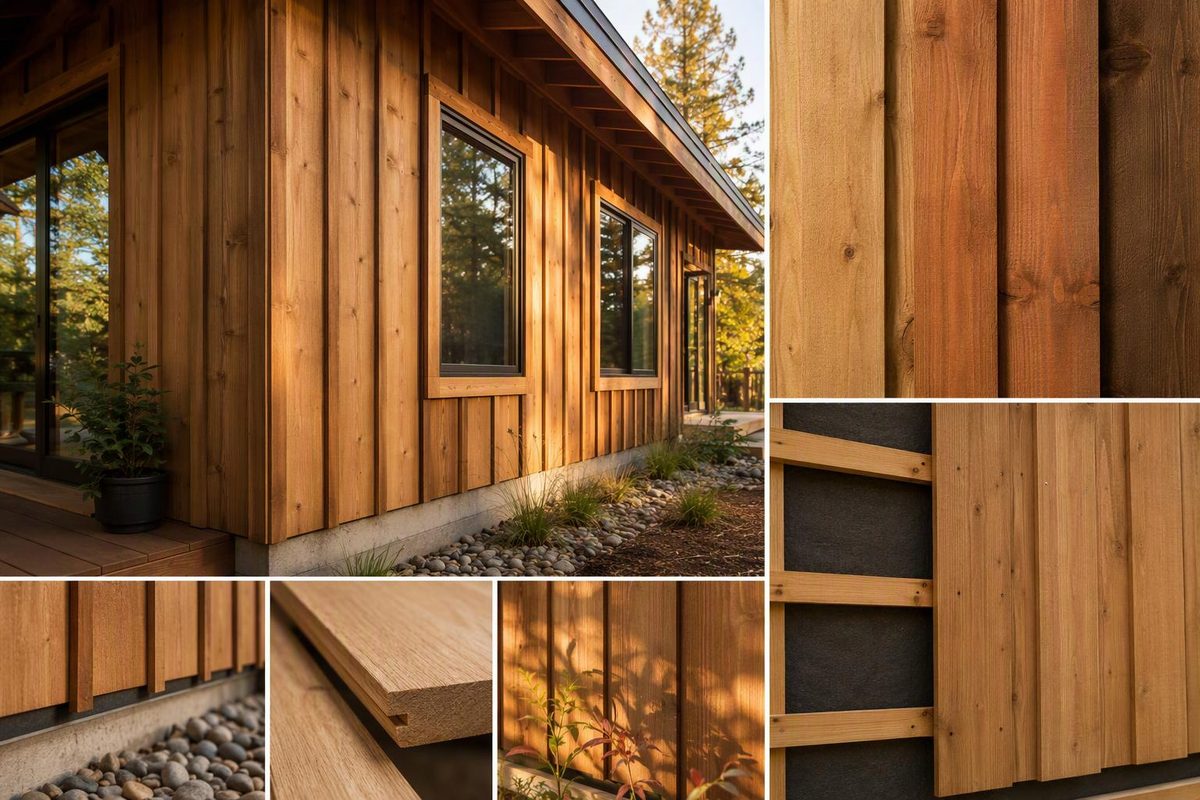
Cedar board and batten is worth choosing when authentic wood grain and deep shadow lines justify recurring finish care. It is a poor fit if you want a highly uniform, low-maintenance or noncombustible cladding. The assembly must drain, and its fastening pattern must allow the boards to move without splitting.
Separate boards and battens create more relief and natural variation than panels molded to imitate the style. In wildfire-prone areas, verify the locally required wall assembly before selecting any wood siding.
Enter the measured exterior wall area to see the cited preliminary installed-cost range.
Preliminary Installed-Cost Range
Enter square feet, not the home’s floor area.
Estimated installed range
$9,000–$24,000
At $6–$16 per square foot installed
This preliminary range does not establish local pricing or define the quoted scope. Removal, repairs, flashing, finish, access and other work must be compared separately.
Source: HomeGuide, accessed September 25, 2026.
Specify More Than “Cedar Board and Batten”
There is no mandatory width combination. The Western Red Cedar Lumber Association (WRCLA) identifies nominal 1x10 boards with 1x3 battens as a common Western red cedar arrangement. Boards can also be installed over battens for a deeper channel effect. Rough-sawn unseasoned stock and boards surfaced on one face and two edges are both sold for this application (WRCLA profile guide).
A useful quote should identify:
- cedar species;
- clear or knotty grade and applicable grading rule;
- kiln-dried or green material;
- nominal and actual dimensions;
- rough, resawn or smooth exposed face;
- solid or finger-jointed stock, if offered in the selected grade;
- finish system and where it will be applied;
- wall membrane, flashing, blocking or furring, and fastening details.
For Western red cedar, clear and knotty are broad categories rather than complete specifications. WRCLA lists multiple board-and-batten grades: clear grades restrict visible growth characteristics to varying degrees, while Select Knotty permits sound, tight knots. Grade names and grading rules therefore matter when comparing bids (WRCLA grade guide).
Installed Cost Depends on the Quoted Scope
For preliminary budgeting, HomeGuide listed cedar board and batten at $6 to $16 per square foot installed when accessed September 25, 2026. That national marketplace range does not establish local pricing or define everything included under “installed” (HomeGuide). Species, grade, finish and availability affect material cost; wall height, openings, trim and access affect labor.
Ask each bidder to include or separately price:
- old-siding removal and disposal;
- sheathing inspection and unit prices for repair;
- weather-resistive barrier and flashing;
- horizontal blocking or furring for the vertical siding;
- boards, battens, trim and waste;
- corrosion-resistant fasteners;
- factory or field finishing, including cut ends;
- access equipment, permits and cleanup.
Do not multiply floor area by a siding rate. Compare quotes using the same measured exterior wall area and scope. Future cleaning, refinishing and access also belong in the ownership cost; see A Cedar Siding House: Cost and Care.
Drainage and Fastening Prevent the Common Failures
The following dimensions and fastening patterns come from WRCLA guidance for Western red cedar. Another species or proprietary product may have different instructions.
Flashing Must Drain Without Depending on Caulk
WRCLA calls for downward-sloped flashing above wall penetrations and at material changes, with siding or trim held 1/4 inch above the flashing ledge. It says caulk is not a substitute for flashing and should not block places intended to drain (WRCLA installation guidance). Missing or incorrectly lapped flashing can direct water behind the finish and into the wall.
Vertical Boards Need Solid Horizontal Fastening Points
Vertical siding needs horizontal blocking or furring. Rigid foam by itself has little or no nail-holding power and is not recommended as the nailing base. WRCLA calls for nails long enough to penetrate solid wood by at least 1 1/4 inches; spacing depends on the supporting wall construction (WRCLA pre-installation guidance). Exterior-insulation thickness, wind loads, structural design and local code still need project-specific review.
Boards and Battens Must Move Separately
In WRCLA’s board-and-batten detail, boards up to 6 inches wide receive one centered nail at each bearing point. Boards 8 inches and wider receive two nails spaced 2 1/2 to 3 inches apart. Each batten is fastened through the gap, not through the edges of both boards beneath it. Pinning overlapping pieces together restrains normal moisture movement and can split the wood (WRCLA installation course).
Bottom Edges Need Clearance From Wet Surfaces
WRCLA specifies at least 6 inches above grade and 2 inches above roofs or decks, plus water repellent on the bottom end grain. Inadequate clearance exposes the siding to splashback and wicking (installation guidance; pre-installation guidance).
Fasteners Must Be Compatible With Cedar
WRCLA permits hot-dipped galvanized, aluminum and stainless-steel nails. It prefers stainless for transparent finishes and recommends Type 316 stainless at seacoast exposures. Plain steel can rust and react with cedar extractives; copper can also react with cedar (WRCLA pre-installation guidance).
For installation sequencing by material, see Install Board and Batten Siding by Type.
Finish Choice Determines the Appearance and Care
Decide on the finish before ordering:
- Paint or solid-color stain provides the most uniform color. Peeling, blistering or flaking is often associated with moisture behind the coating or poor adhesion.
- Semi-transparent penetrating stain retains more grain and is comparatively straightforward to renew. A textured face generally accepts more finish than a smooth face.
- Natural weathering avoids maintaining a coating but does not eliminate cleaning or moisture management. Uneven sun and moisture exposure commonly produces blotchy gray rather than uniform silver.
WRCLA says new cedar should be clean and dry, with moisture content no higher than 20%. Wood exposed to weather for more than two weeks may need additional surface preparation. It also warns against using pressure washing to remove coatings because it can damage wood fibers and impair the next finish’s adhesion (WRCLA finishing guidance).
Finish life is not a universal number. Exposure, texture, coating system, preparation and workmanship all change the interval. An annual inspection should cover bottom ends, window heads, roof intersections, failed sealant, loose battens, mildew and dark fastener stains. Refinish when the coating has worn thin rather than according to an arbitrary calendar.
The Written Specification Matters More Than the Look
Cedar board and batten suits buyers who value real grain, pronounced shadow lines and replaceable individual pieces enough to accept periodic cleaning and refinishing. Its principal risks are trapped water, restrained board movement, wet end grain, incompatible fasteners and neglected coatings.
Before signing, require the species, grade, moisture condition, dimensions, fastening pattern, drainage details and finish schedule in writing. A quote covering only batten spacing and color describes the appearance, not the wall assembly that must survive behind it.